If you are interested in products and services related to the research phase in this field, please contact for further inquiries.
Auditory feedback (aFB) represents a significant advancement in the field of neurorehabilitation, particularly for individuals with central nervous system (CNS) lesions. These lesions, often resulting from conditions such as stroke, spinal cord injury, and multiple sclerosis, frequently impair balance and gait, necessitating the use of walking aids like crutches. Traditional rehabilitation methods, while effective, often lack the objective, real-time feedback necessary to optimize crutch usage. The introduction of auditory feedback addresses this gap by providing immediate, actionable information to both patients and physical therapists, enhancing adherence to rehabilitation protocols and improving functional outcomes.
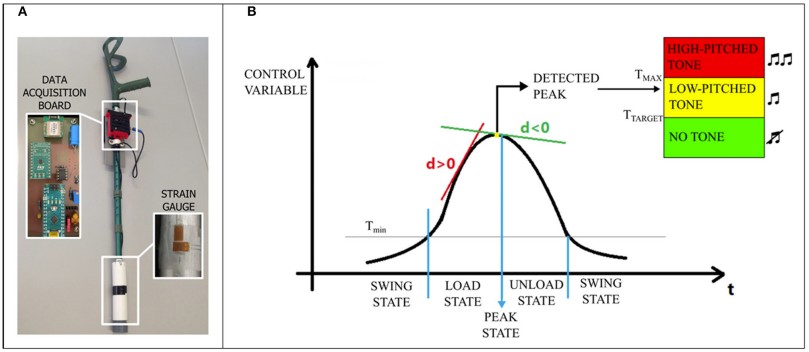 Fig.1 Instrumented crutch (A) and peak detection algorithm description (B). (Tamburella F., et al., 2021)
The Role of Crutches in Rehabilitation
Crutches are a fundamental tool in the rehabilitation of individuals with CNS lesions. They serve two primary functions: reducing the load on the legs and increasing the body's base of support to improve balance. Proper use of crutches is critical for effective rehabilitation, but assessing this usage in clinical settings has historically been challenging. Traditional methods rely on subjective observations, which can be inconsistent and imprecise. The integration of sensors into crutches, however, offers a solution by providing objective, quantitative data on crutch load and usage patterns.
The Mechanism of Auditory Feedback
Auditory feedback operates on the principle that immediate, sensory information can significantly enhance patient awareness and adherence to prescribed rehabilitation protocols. In a recent pilot study, instrumented crutches equipped with strain gauges and custom software were used to deliver concurrent auditory feedback. These crutches were designed to emit different sounds based on the load applied, with thresholds set at the 40th, 82nd, and 97th percentiles of the load distribution. This system allowed participants to receive real-time auditory cues, facilitating immediate adjustments to their crutch usage.
The Pilot Study: Methodology and Design
The pilot study was meticulously designed to evaluate the impact of auditory feedback on crutch usage in individuals with CNS lesions. Twelve participants, including individuals with subacute or chronic stroke, spinal cord injury, and multiple sclerosis, were recruited from rehabilitation centers in Italy. The study involved a single experimental session with several phases, including baseline evaluation, familiarization, testing, and experience assessment.
Baseline Evaluation
Participants walked a 10-meter path at their self-selected comfortable speed, with crutch load data recorded to set the load thresholds for subsequent testing phases. This initial assessment provided a baseline against which the effectiveness of auditory feedback could be measured.
Familiarization Phase
Participants were introduced to the auditory feedback system through a familiarization phase, during which they walked with both auditory feedback and verbal instructions from a physical therapist. This phase aimed to acclimate participants to the system and ensure they understood how to respond to the auditory cues.
Testing Phase
The testing phase involved participants walking three times with auditory feedback and three times without it, in a randomized order. Their performance was recorded using the 10-Meter Walk Test (10MWT), and fatigue levels were assessed using the Borg scale. This randomized design allowed for a direct comparison between conditions, providing robust data on the impact of auditory feedback.
Experience Assessment
Both participants and physical therapists completed detailed questionnaires to evaluate the usability, satisfaction, and perceived benefits of the auditory feedback system. This qualitative data provided valuable insights into the user experience and the system's practicality in clinical settings.
Results: The Impact of Auditory Feedback
- Load Data Analysis
The study's results were striking. Auditory feedback significantly reduced the mean load on the crutches during walking, with a reduction of approximately 0.9 kg (p = 0.001). The percentage of correct load peaks, defined as those below the selected threshold, was also significantly higher with auditory feedback, increasing by 19.7% (p = 0.003). These findings indicate that auditory feedback enhances participants' ability to control crutch load, aligning more closely with rehabilitation goals.
- Gait Speed and Fatigue
Auditory feedback did not significantly affect gait speed or fatigue levels. The 10MWT results showed no significant differences in walking speed between the feedback and no-feedback conditions (p > 0.05). Similarly, the Borg scale scores for fatigue were comparable, suggesting that auditory feedback did not impose additional physical strain on participants. This is a crucial finding, as it indicates that auditory feedback can improve crutch usage without compromising mobility or increasing fatigue.
- User Experience and Satisfaction
Participants and physical therapists reported overwhelmingly positive experiences with the auditory feedback system. The ad-hoc feedback questionnaire revealed that participants found the auditory feedback useful, easy to learn, and non-distracting. The average utility/usability score was 5.07 ± 1.81, and the learnability score was 5.87 ± 1.64. Physical therapists also expressed high satisfaction with the system, rating it highly on the System Usability Scale (SUS) and the Quebec User Evaluation of Satisfaction with assistive technology 2.0 (QUEST 2.0).
Discussion: Implications for Rehabilitation
The study's findings have significant implications for the field of neurorehabilitation. The significant reduction in crutch load suggests that auditory feedback can improve adherence to rehabilitation protocols without compromising gait speed or increasing fatigue. This immediate feedback mechanism allows patients to make real-time adjustments, potentially enhancing neuroplasticity and functional recovery.
Collaborative Rehabilitation
The positive feedback from both participants and physical therapists underscores the importance of collaborative rehabilitation efforts. Effective communication and feedback between patients and therapists are crucial for successful rehabilitation outcomes. The auditory feedback system appears to facilitate this collaboration by providing objective, real-time data that can guide therapeutic interventions.
Future Directions
While the pilot study demonstrated promising results, further research is needed to explore the long-term effects of auditory feedback on crutch usage and rehabilitation outcomes. Future studies should include larger sample sizes and longitudinal assessments to determine the optimal timing and duration of auditory feedback interventions. Additionally, exploring the applicability of this technology across different types of CNS lesions and rehabilitation phases could provide valuable insights into personalized rehabilitation strategies.
Conclusion
The integration of auditory feedback into crutch-assisted rehabilitation represents a significant advancement in neurorehabilitation. By providing real-time, objective feedback, this technology enhances patients' ability to control crutch load, potentially improving functional outcomes and independence. The positive user experience and high satisfaction levels among both patients and therapists suggest that auditory feedback systems could become a valuable tool in clinical rehabilitation settings. As research continues to explore the potential of wearable technologies in rehabilitation, the future looks promising for enhancing mobility and quality of life for individuals with CNS lesions.
If you have related needs, please feel free to contact us for more information or product support.
Reference
- Tamburella, Federica, et al. "Load auditory feedback boosts crutch usage in subjects with central nervous system lesions: A pilot study." Frontiers in Neurology 12 (2021): 700472.
This article is for research use only. Do not use in any diagnostic or therapeutic application.
Crutches Series