If you are interested in products and services related to the research phase in this field, please contact for further inquiries.
Knee osteoarthritis (KOA) is a prevalent degenerative joint disease, primarily affecting the middle-aged and elderly populations. Characterized by cartilage degradation, bone overgrowth, and joint inflammation, KOA significantly impacts mobility and quality of life. Traditional treatments, including medication, physical therapy, and surgery, often fall short due to their invasive nature, side effects, and inability to provide long-term relief. The need for non-invasive, personalized, and effective solutions has led to significant advancements in orthotic technology.
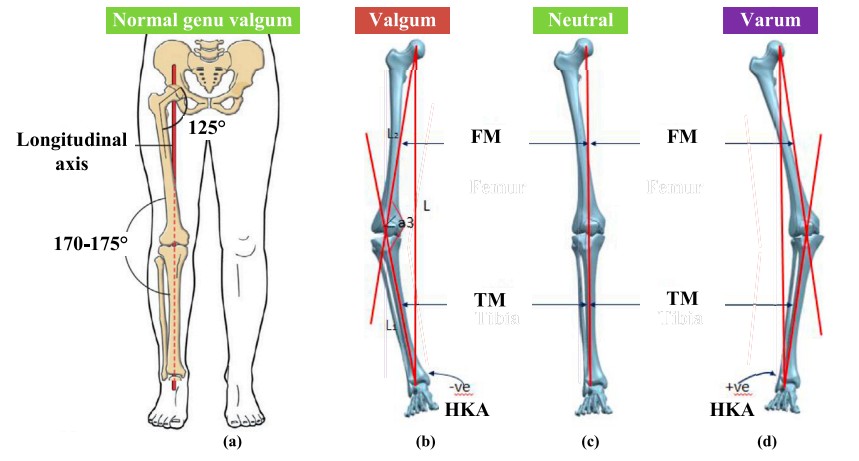 Fig.1 Human lower limb force line. (A) Straight line connecting center of femoral head, knee and ankle joint. (B) The genu varum of knee joint. (C) The neutral knee joint. (D) The genu valgus of knee joint. LBA is the lower limb mechanical load line, FM is the femoral axis, TM is the tibial axis. (Zhou X., et al., 2024)
The Evolution of Knee Orthosis Technology
Historically, knee orthosis has been a cornerstone in managing KOA. Traditional orthosis designs, however, have been limited by their fixed adjustment angles, bulkiness, and discomfort during prolonged use. These limitations have prompted the development of more advanced orthosis technologies that prioritize adjustability, comfort, and personalized fit. The introduction of lightweight materials, structural optimization, and advanced biomechanical principles has revolutionized the field, leading to the development of adaptive knee orthosis.
Biomechanical Principles Underpinning Adaptive Knee Orthosis
Adaptive knee orthosis operates on the principle of four-point force application, which involves exerting pressure on both sides of the knee joint to create a corrective torque. This torque helps realign the lower limb's mechanical axis, reducing pressure on the medial compartment and alleviating joint pain. The orthosis is designed to mimic the natural biomechanics of the knee joint, ensuring minimal interference with normal movement while providing the necessary support and correction.
Structural Design and Optimization of Adaptive Knee Orthosis
The design of the adaptive knee orthosis is a testament to advanced engineering principles. Utilizing lightweight materials and structural optimization techniques, the orthosis achieves a balance between strength and weight reduction. The device features a mechanical structure that allows for step-by-step pressure adjustment, enabling patients to customize the device to their specific needs. The orthosis weighs only 324 grams, making it significantly lighter than many existing products.
Mechanism of Adjustment
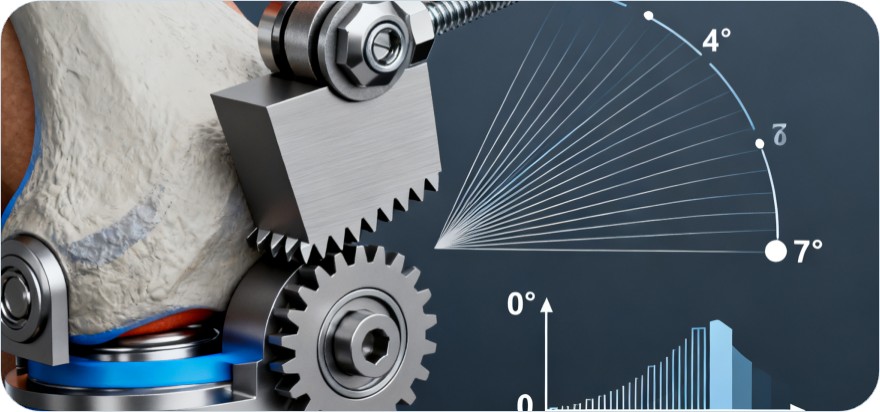
The orthosis incorporates a screw-driven mechanism that moves a toothed wedge block towards the knee joint. This movement pushes a lever arm outward, transferring pressure to the knee joint. The device features a ratchet mechanism that ensures one-way transmission and reverse self-locking, providing stable correction. The orthosis can achieve an angular range adjustment of 0° to 7° and provide a corrective force of 0 to 10N.
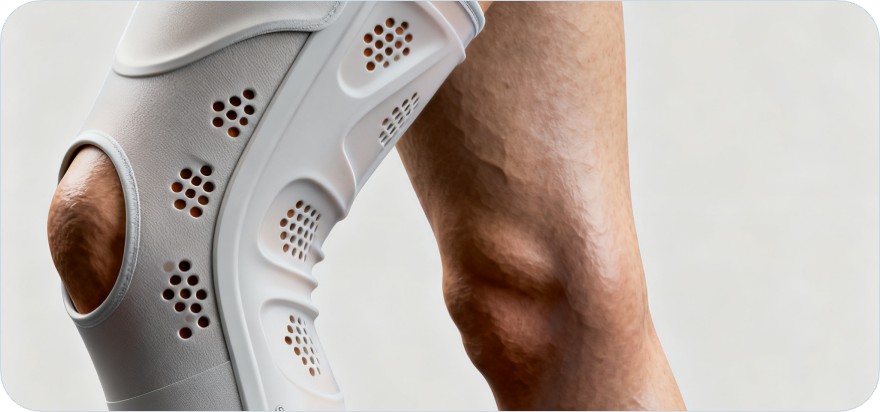
Wearable Structure Design
To ensure a perfect fit and enhance comfort, the researchers utilized three-dimensional (3D) scanning technology to create a detailed model of the human leg surface. This allowed for the design of a semi-enclosed wearable structure that conforms to the leg's contours, providing even pressure distribution and minimizing discomfort. The wearable structure features multiple pores for efficient heat dissipation and sweat evaporation, further enhancing user comfort.
Experimental Validation and Functional Evaluation
Pressure Test System
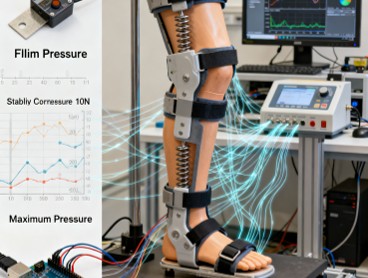
To validate the design, the researchers conducted a series of physical experiments using a pressure test system. The system consisted of thin film pressure sensors, an Arduino microcontroller, and a computer for data acquisition and analysis. The orthosis was tested on a leg model with springs of different stiffness coefficients to simulate the human leg's mechanical properties. The results showed that the orthosis could achieve stable pressure adjustments, with the ability to exert a maximum corrective pressure of 10N.
Plantar Pressure Test
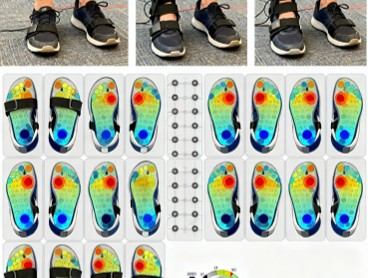
In addition to the physical tests, the researchers conducted functional evaluations using a plantar pressure test. This involved placing pressure sensors in the shoes of 15 subjects to measure the pressure distribution on the foot before and after wearing the orthosis. The results indicated a significant reduction in pressure on the lateral side of the foot, particularly in lighter individuals, demonstrating the orthosis's ability to correct lower limb alignment and reduce joint load.
Future Directions and Clinical Implications
The development of the wedge-shaped adaptive knee orthosis represents a significant step forward in the management of KOA. Future research should focus on optimizing the mechanical model of the knee joint to account for the complex interactions between muscles, ligaments, and bones. Establishing a human-machine coupling analysis system could provide deeper insights into the interaction between the orthosis and the human body, leading to further improvements in design and functionality.
Clinical trials involving a larger number of patients with varying degrees of KOA are needed to fully assess the orthosis's long-term effects on joint health and patient mobility. Parameters such as walking speed, range of motion, and gait patterns should be closely monitored to evaluate the device's performance comprehensively.
Conclusion
The introduction of the wedge-shaped adaptive knee orthosis marks a new era in the treatment of knee osteoarthritis. By combining advanced biomechanical principles, structural optimization, and personalized design, this innovative device offers a lightweight, adjustable, and effective solution for managing KOA. As research continues and clinical trials expand, the potential for this orthosis to transform the lives of millions of KOA patients becomes increasingly evident.
If you have related needs, please feel free to contact us for more information or product support.
Reference
- Zhou, Xin, et al. "Design and evaluation of a wedge-shaped adaptive knee orthosis for the human lower limbs." Frontiers in Bioengineering and Biotechnology 12 (2024): 1439616.
This article is for research use only. Do not use in any diagnostic or therapeutic application.
Lower Limb Fixation Series