

- Home
- IVD
- By Technology Types
- By Diseases Types
- By Product Types
- Research
- Resource
- Distributors
- Company
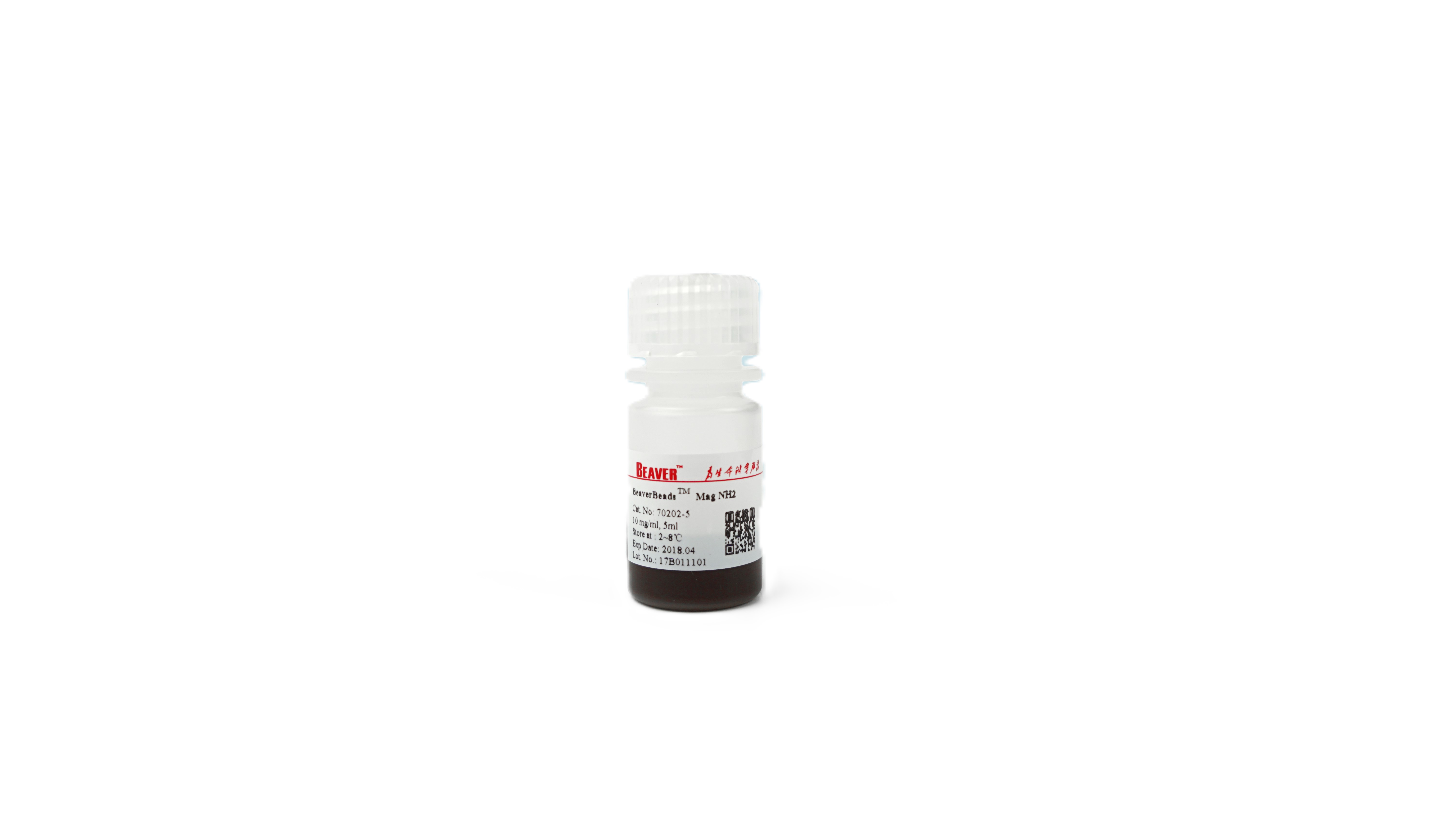
| Product Name | Magrose NH2 (10-30 µm) |
| Catalog No. | SM-HMM-0018 |
| Description | Agarose-coated magnetic beads can be used for enrichment, separation and purification of biomolecule (proteins, peptides, oligonucleotides, drug molecules, etc.). They have abundant active functional groups, faster magnetic responsiveness, and lower non-specific adsorption. |
| Features | Rich amino content: ~50 µmol /mL gel; Good operation performance: the magnetic beads are uniformly dispersed, superparamagnetic, and the magnetic response time is <10s; Good stability and batch-to-batch reproducibility, CV of amino acid content between batches <5%; High binding capacity of target substances, low non-specific adsorption: specialized in separation and purification. |
| Average Particle Size | 10-30 µm |
| Surface Group / Content | NH2(~50 µM/mL gel) |
| Magnetic Core | Fe3O4 |
| Shell | Agarose |
| Magnetism Type | Superparamagnetic |
| Saturation Magnetization Strength | 41.09 emu/g |
| Concentration | 20% (v/v) |
Magnetic beads have become indispensable tools in modern biological research, revolutionizing the processes of biomolecule separation and purification. Among various types of magnetic beads, agarose-coated magnetic beads stand out for their biocompatibility and versatility, making them widely used in fields such as proteomics, genomics, and drug discovery.
Biomolecule research often requires efficient enrichment and purification of target substances, as impure samples can interfere with experimental results and reduce research efficiency. Traditional separation methods, such as centrifugation and chromatography, are often time-consuming, labor-intensive, and have limitations in specificity and yield.
Magnetic beads modified with functional groups address these challenges by enabling rapid separation under magnetic fields, combined with high specificity for target biomolecules. The amino group (-NH2) is a commonly used functional group for magnetic bead modification, as it can form stable covalent bonds with various molecules (such as carboxyl-containing compounds) through chemical reactions like amidation, expanding the scope of application.
Magrose NH2 (10-30 µm) is developed based on this technical background, integrating the advantages of agarose matrices and superparamagnetic cores. It is designed to meet the growing demand for high-performance biomolecule separation tools in research laboratories, providing reliable support for experiments such as protein purification, peptide enrichment, and oligonucleotide immobilization.
Rich amino content with a concentration of ~50 µmol/mL gel, ensuring sufficient binding sites for target biomolecules and enhancing the efficiency of enrichment and purification.
Uniform particle size distribution (10-30 µm) promotes consistent performance in experiments, avoiding the negative impact of uneven particle sizes on reaction kinetics and separation results.
Superparamagnetic property allows for fast magnetic response time (<10s), enabling rapid separation of magnetic beads from samples without the need for complex centrifugation steps, saving experimental time.
Agarose shell material offers excellent biocompatibility, reducing non-specific adsorption of biomolecules and ensuring high purity of the isolated target substances.
Good stability and batch-to-batch reproducibility, with the coefficient of variation (CV) of amino acid content between batches <5%, ensuring reliable and consistent experimental results across different batches.
High saturation magnetization strength (41.09 emu/g) ensures strong magnetic responsiveness, facilitating complete separation of magnetic beads even in complex sample matrices.
Concentration of 20% (v/v) provides a balanced ratio of magnetic beads to reaction volume, optimizing the interaction between magnetic beads and target molecules while minimizing reagent waste.
Efficient binding and separation: The combination of rich amino groups and superparamagnetic cores enables rapid binding to target biomolecules and fast magnetic separation, significantly improving experimental efficiency compared to traditional methods.
Low non-specific adsorption: The agarose shell and optimized surface modification reduce the adsorption of non-target molecules, ensuring high purity of the isolated products and reducing interference in subsequent experiments.
Easy to operate: No special equipment is required except for a magnetic separator. The simple operation process lowers the threshold for use and is suitable for various laboratory environments.
Wide applicability: Compatible with multiple biomolecules including proteins, peptides, oligonucleotides, and drug molecules, meeting the diverse needs of different research fields.
Reliable batch consistency: Strict quality control ensures minimal variation between batches, allowing researchers to obtain stable experimental results and avoid repeated validation of different batches.
Biocompatible and safe: The agarose matrix is non-toxic and biocompatible, ensuring no adverse effects on the structure and activity of biomolecules, which is crucial for subsequent functional studies.
For research use only, not for clinical use.
|
There is no product in your cart. |
Copyright © 2026 Alta DiagnoTech. All rights reserved.