

- Home
- IVD
- By Technology Types
- By Diseases Types
- By Product Types
- Research
- Resource
- Distributors
- Company
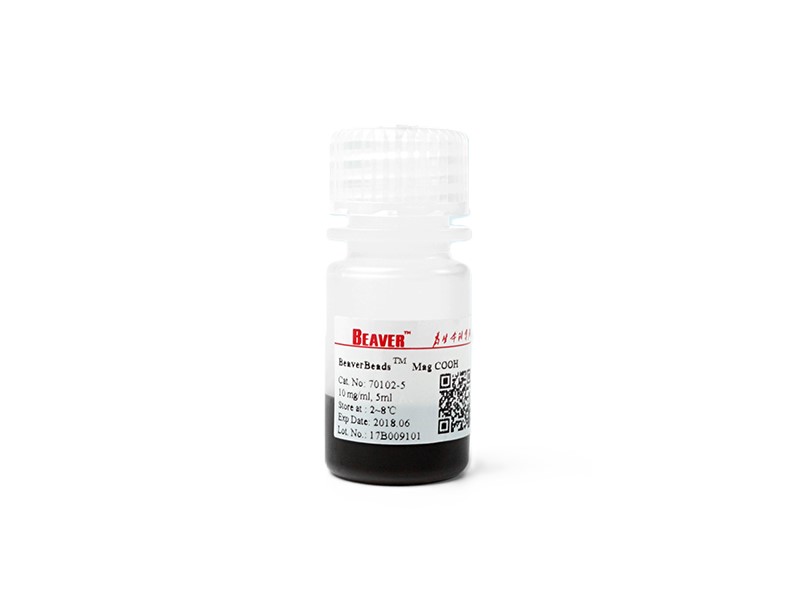
| Product Name | Mag COOH-300 nm |
| Catalog No. | SM-HMM-0015 |
| Description | Polymer-coated magnetic beads have rich functional COOH or NH2 groups, which are capable of covalently immobilizing biological ligands, such as peptides, proteins, antibodies and oligonucleotides. These magnetic beads can be used for immunology detection and molecular biology research. |
| Average Particle Size | 300 nm |
| Surface Group / Content | COOH (~60 µmol/g) |
| Magnetic Core | Fe3O4 |
| Shell | Polymer |
| Magnetism Type | Superparamagnetic |
| Preservation Fluid | 20% ethanol |
| Concentration | 10 mg/mL |
| Applications | Protein Purification Immunoassay Cell Sorting Specific Nucleic Acid Isolation Biosensors Drug Screening and Delivery |
Magnetic beads have become indispensable tools in modern scientific research, revolutionizing workflows in molecular biology, immunology, and related fields. Their unique combination of magnetic responsiveness and surface functionalization enables precise manipulation and isolation of target biomolecules, cells, or analytes with unparalleled efficiency.
In the context of research applications, the demand for magnetic beads with well-defined properties—such as consistent particle size, high surface functional group density, and reliable superparamagnetism—has grown exponentially. Traditional separation techniques, such as centrifugation or chromatography, often suffer from limitations including time-consuming protocols, low recovery rates, and difficulty in scaling up. Magnetic beads address these challenges by allowing rapid separation under external magnetic fields, eliminating the need for complex equipment and reducing processing time from hours to minutes.
The Mag COOH-300 nm is engineered to meet the rigorous requirements of academic and industrial research. Its core-shell structure integrates a superparamagnetic Fe₃O₄ core with a polymer shell, a design optimized to balance magnetic responsiveness and biocompatibility. The surface-functionalized COOH groups serve as versatile anchors for covalent conjugation with biological ligands, a critical feature for applications requiring specific and stable binding.
Key drivers behind the development of this product include:
The need for high-purity biomolecule isolation to support downstream analyses such as mass spectrometry, PCR, and sequencing.
The demand for reproducible results in immunoassays and cell sorting, where batch-to-batch consistency directly impacts research outcomes.
The trend toward miniaturized and high-throughput research workflows, which require tools that are both efficient and easy to integrate into automated systems.
The requirement for biocompatible materials that minimize non-specific binding, ensuring the integrity and activity of isolated biological samples.
Precise Particle Size Control: Average particle size of 300 nm, ensuring uniform dispersion in solution and consistent interaction with target molecules. This size balance optimizes both magnetic responsiveness and surface area for ligand conjugation.
High-Density COOH Groups: Surface COOH content of ~60 µmol/g, providing abundant reactive sites for covalent binding to peptides, proteins, antibodies, and oligonucleotides.
Superparamagnetic Core: Fe₃O₄ magnetic core exhibits superparamagnetism, enabling fast and complete separation under external magnetic fields without residual magnetism after field removal.
Biocompatible Polymer Shell: The polymer shell protects the magnetic core while ensuring low non-specific binding, preserving the activity of biological samples during isolation and purification.
Stable Preservation: Formulated in 20% ethanol preservation fluid, maintaining product stability and performance during storage at 2–8°C for extended periods.
Consistent Concentration: Supplied at a standardized concentration of 10 mg/mL, facilitating accurate dosing and reducing experimental variability.
Enhanced Binding Specificity: Covalent conjugation via COOH groups ensures stable and specific attachment of ligands, minimizing dissociation during washing and separation steps compared to non-covalent binding methods.
Efficient Magnetic Separation: Superparamagnetic properties enable rapid sedimentation under mild magnetic fields, reducing processing time and improving workflow efficiency for high-throughput experiments.
Superior Sample Integrity: Low non-specific binding and biocompatible polymer shell protect the structure and activity of isolated proteins, cells, or nucleic acids, supporting reliable downstream analysis.
Broad Application Versatility: Suitable for a wide range of research applications, from protein purification and immunoassays to cell sorting and nucleic acid isolation, eliminating the need for multiple specialized tools.
Batch-to-Batch Consistency: Rigorous quality control ensures uniform particle size, functional group density, and magnetic performance across production batches, ensuring reproducible research results.
Easy Integration: Compatible with both manual and automated research workflows, adapting to diverse laboratory setups and scaling requirements.
For research use only, not for clinical use.
|
There is no product in your cart. |
Copyright © 2026 Alta DiagnoTech. All rights reserved.