

- Home
- IVD
- By Technology Types
- By Diseases Types
- By Product Types
- Research
- Resource
- Distributors
- Company
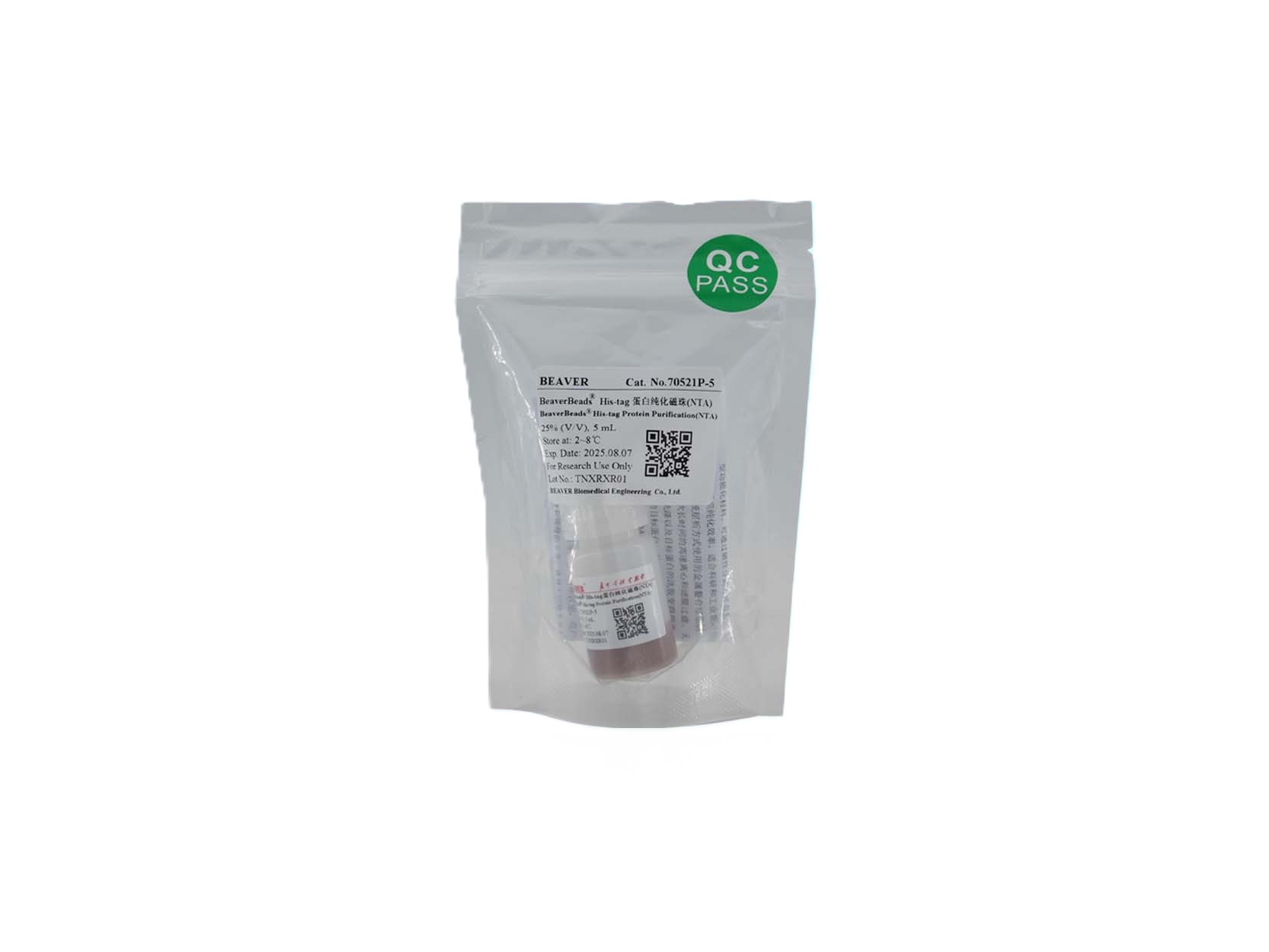
| Product Name | His-tag Protein Purification Beads (NTA-Ni) |
| Catalog No. | SM-HMM-0060 |
| Features | Direct purification of target proteins from crude samples, greatly reducing the purification time; Easily control the concentration and volume of target protein; High purity of target protein can be obtained in one step; High stability of parallel operation, which is convenient for high throughput and large-scale protein purification; High yield of target protein can be obtained; Reusable and easy to regenerate. |
| Storage | 2-8°C |
| Shelf Life | 2 years |
| Average Particle Size | 10-30 µm |
| Concentration | 25% (v/v) |
In the field of life sciences and biotechnology, recombinant protein production plays a critical role in various applications, ranging from basic research (such as protein structure and function studies) to industrial manufacturing (including biopharmaceutical development, enzyme production, and diagnostic reagent preparation). Among the entire recombinant protein production workflow, downstream protein purification is a key step that directly determines the quality, yield, and application value of the final product. Due to the inherent diversity in chemical composition and structural characteristics of recombinant proteins, it is extremely challenging to separate target proteins from complex biological matrices (e.g., bacterial lysates, yeast supernatants, or mammalian cell cultures) efficiently and specifically.
To address this challenge, affinity tags have emerged as a powerful and widely adopted tool for high-throughput protein purification. These tags are short peptide sequences fused to the target protein via genetic engineering, enabling specific binding to corresponding ligands or matrices. Among the various affinity tags available, the His-tag (typically consisting of 6 consecutive histidine residues) stands out as one of the most popular choices in both academic and industrial settings.
The core principle behind His-tag protein purification lies in the coordination interaction between the imidazole ring of histidine residues and transition metal ions (such as Ni²⁺, Co²⁺, Cu²⁺, or Zn²⁺). In the case of NTA-Ni (Nitrilotriacetic Acid-Nickel) purification beads, the NTA ligand is covalently coupled to the bead matrix, and it can chelate Ni²⁺ ions through its three coordination sites. The His-tag on the target protein then binds to the Ni²⁺ ions via the imidazole groups, allowing for the specific capture of the target protein from crude samples. During the purification process, non-target proteins and impurities are washed away using a low-concentration imidazole buffer, while the target protein is eluted by increasing the imidazole concentration (which competes with the His-tag for Ni²⁺ binding) or adjusting the buffer pH (to weaken the coordination interaction between the His-tag and Ni²⁺).
With the growing demand for efficient, high-purity, and cost-effective protein purification solutions, NTA-Ni-based His-tag protein purification beads have become an indispensable tool. They address the limitations of traditional purification methods (such as low specificity, complex operation, and high equipment costs) by offering a streamlined workflow that can be completed in a short time, even by researchers with limited experience. Whether for small-scale laboratory protein purification (e.g., purifying milligram-level proteins for enzymatic activity assays) or large-scale industrial production (e.g., preparing gram-level recombinant proteins for drug development), NTA-Ni His-tag purification beads provide a reliable and scalable solution.
Direct Purification from Crude Samples: Skip time-consuming pre-treatment steps (such as multiple centrifugation or filtration cycles) for crude samples (e.g., bacterial lysates, yeast culture supernatants). The beads can directly bind to the His-tagged target protein in complex matrices, significantly shortening the overall purification time and reducing the risk of protein loss or degradation during pre-processing.
Flexible Control Over Target Protein Concentration and Volume: Adjust the volume of the elution buffer to precisely control the final concentration and volume of the purified target protein. This flexibility is particularly useful for downstream applications that require specific protein concentrations (e.g., 1 mg/mL for antibody conjugation or 10 μg/mL for cell signaling assays) and eliminates the need for additional concentration steps (such as ultrafiltration) that may cause protein aggregation.
High Purity Achieved in a Single Step: Leverage the strong and specific coordination interaction between the NTA-chelated Ni²⁺ ions and the His-tag. This specificity ensures that non-target proteins, nucleic acids, and other impurities are efficiently removed during the washing step, resulting in target protein purity of up to 95% or higher in just one purification cycle—no need for multiple rounds of purification (e.g., ion exchange or gel filtration chromatography) to meet purity requirements.
High Stability for Parallel Operations: Maintain consistent binding capacity and purification performance across multiple batches of beads and parallel experiments. The uniform particle size (10-30 μm) and stable NTA-Ni coupling ensure that the beads behave predictably in high-throughput workflows (e.g., 96-well plate-based purification for screening multiple protein variants) or large-scale production, with minimal variation in yield and purity between samples.
High Target Protein Yield: The high ligand density (NTA groups per bead) and efficient Ni²⁺ chelation enable the beads to capture a large amount of His-tagged protein per unit volume. For most soluble His-tagged proteins expressed in E. coli, the yield typically ranges from 70% to 80%—significantly higher than traditional non-affinity purification methods (e.g., ammonium sulfate precipitation, which often yields <50% of the target protein).
Time Efficiency: Cut down the total purification time to less than 1 hour (from sample loading to elution). Traditional column chromatography often requires 2-3 hours (including column packing, equilibration, and gradient elution), while our NTA-Ni beads eliminate the need for column setup and slow flow rate control, making it ideal for time-sensitive experiments (e.g., purifying fresh proteins for same-day activity assays).
Cost-Effectiveness: Reduce both upfront and recurring costs. Unlike expensive column chromatography systems (which require thousands of dollars in equipment), our beads only need a magnetic separator (for magnetic bead formats) or a simple gravity column (for non-magnetic formats)—minimizing initial equipment investment. Additionally, the reusability of the beads lowers the cost per purification cycle compared to single-use purification columns.
User-Friendliness: Require minimal technical expertise to operate. The workflow is straightforward: mix the beads with the sample, incubate to allow binding, wash away impurities, and elute the target protein. No specialized training in column operation (e.g., adjusting flow rates, monitoring pressure) is needed, making it accessible to students, early-career researchers, and lab technicians with limited purification experience.
Scalability: Adapt seamlessly to different purification scales. Whether you need to purify 100 μg of protein for a small-scale experiment or 100 mg for industrial production, the beads can be scaled up or down by adjusting the volume of beads used. This scalability eliminates the need to switch between different purification platforms (e.g., from small columns to large-scale chromatography systems) when changing production volumes.
Low Interference with Downstream Applications: Ensure the purified target protein is suitable for a wide range of downstream uses. The His-tag can be easily removed (if needed) using specific proteases (e.g., thrombin or enterokinase), and the mild elution conditions (imidazole is compatible with most enzymatic assays, cell cultures, and protein crystallization buffers) mean the purified protein can be directly used without extensive buffer exchange—saving time and reducing the risk of protein damage.
For research use only, not for clinical use.
|
There is no product in your cart. |
Copyright © 2026 Alta DiagnoTech. All rights reserved.