

- Home
- IVD
- By Technology Types
- By Diseases Types
- By Product Types
- Research
- Resource
- Distributors
- Company
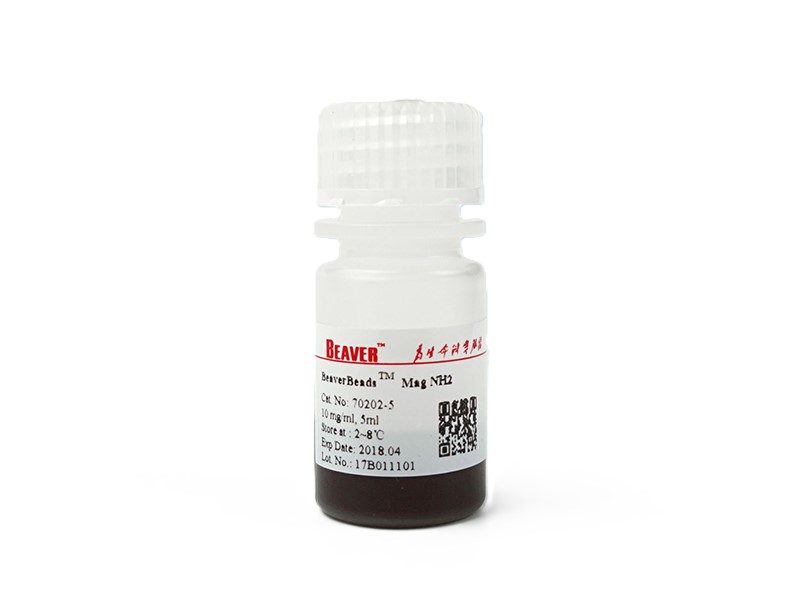
| Product Name | Magrose NH2 (30-150 µm) |
| Catalog No. | SM-HMM-0021 |
| Description | Agarose-coated magnetic beads can be used for enrichment, separation and purification of biomolecule (proteins, peptides, oligonucleotides, drug molecules, etc.). They have abundant active functional groups, faster magnetic responsiveness, and lower non-specific adsorption. |
| Features | Rich amino content: ~50 µmol /mL gel; Good operation performance: the magnetic beads are uniformly dispersed, superparamagnetic, and the magnetic response time is <10s; Good stability and batch-to-batch reproducibility, CV of amino acid content between batches <5%; High binding capacity of target substances, low non-specific adsorption: specialized in separation and purification. |
| Storage | Stable at 2-8°C (can be stored or transported at room temperature for short periods of time) |
| Shelf Life | 2 years |
| Average Particle Size | 30-150 µm |
| Surface Group / Content | NH2(~50 µM/mL gel) |
| Magnetic Core | Fe3O4 |
| Shell | Agarose |
| Magnetism Type | Superparamagnetic |
| Saturation Magnetization Strength | 41.09 emu/g |
| Concentration | 20% (v/v) |
Magnetic beads have become indispensable tools in modern biological research, revolutionizing the processes of biomolecule separation, purification, and enrichment. Among various types of magnetic beads, agarose-coated magnetic beads stand out for their biocompatibility and versatility, making them widely used in fields such as proteomics, genomics, drug discovery, and molecular diagnostics.
The core demand for reliable biomolecule handling tools stems from the need for high-purity samples in research experiments. Impure samples can lead to inaccurate results, wasted resources, and delayed research progress. Agarose-coated magnetic beads address this challenge by combining the unique properties of agarose and magnetic materials.
Agarose, a natural polysaccharide derived from seaweed, offers excellent biocompatibility, low toxicity, and a porous structure that provides a large surface area for functionalization. When coated onto magnetic cores (such as Fe₃O₄), the resulting beads gain magnetic responsiveness, enabling fast and efficient separation via external magnetic fields—eliminating the need for time-consuming centrifugation or filtration steps.
Magrose NH2 (30-150 µm) is designed to meet the specific needs of researchers seeking high-performance amino-functionalized magnetic beads. The amino (-NH₂) groups on the surface serve as active sites for covalent binding with various biomolecules (including proteins, peptides, oligonucleotides, and drug molecules) through reactions like carbodiimide-mediated coupling. This functionalization expands the bead’s applicability across a wide range of research workflows, from antibody purification to nucleic acid extraction and drug-target interaction studies.
As research requirements become more stringent, the demand for magnetic beads with consistent performance, low non-specific adsorption, and high binding capacity continues to grow. Magrose NH2 (30-150 µm) is engineered to meet these criteria, supporting reliable and reproducible results in academic and industrial research settings.
Rich amino content (~50 µmol/mL gel) provides abundant active sites for efficient conjugation with target biomolecules, ensuring high binding efficiency in various reaction systems.
Uniform particle size distribution (30-150 µm) promotes consistent performance across experiments, reducing variability and enhancing data reproducibility.
Superparamagnetic properties enable rapid magnetic response (<10s), facilitating fast separation and purification processes that save valuable research time.
Agarose shell offers excellent biocompatibility and low non-specific adsorption, minimizing interference from unwanted biomolecules and ensuring high-purity sample recovery.
Good stability under standard storage conditions (2-8°C) and short-term room temperature storage/transportation provides flexibility in laboratory management and logistics.
Batch-to-batch reproducibility with CV of amino acid content <5% ensures consistent performance across different product lots, avoiding experimental inconsistencies.
High saturation magnetization strength (41.09 emu/g) ensures strong magnetic responsiveness, enabling complete and efficient separation even in complex sample matrices.
20% (v/v) concentration is optimized for convenient use, allowing easy dilution or direct application in standard research protocols.
Superior binding capacity for biomolecules: The combination of rich amino functional groups and the porous agarose structure maximizes the surface area available for binding, enabling efficient capture of target substances even at low concentrations.
Time and labor savings: Fast magnetic response and straightforward separation process eliminate the need for centrifugation or filtration, streamlining workflow and increasing laboratory productivity.
Reduced experimental errors: Low non-specific adsorption and high batch-to-batch reproducibility minimize background noise and variability, leading to more accurate and reliable research results.
Versatile applicability: Compatible with a wide range of biomolecules (proteins, peptides, oligonucleotides, drug molecules, etc.) and research workflows, making it a multi-purpose tool for diverse research needs.
Easy handling and storage: Stable at 2-8°C with short-term room temperature tolerance, and uniform dispersion characteristics simplify sample preparation and storage management.
Cost-effective research support: High performance and reliability reduce the need for repeated experiments or additional purification steps, lowering overall research costs.
For research use only, not for clinical use.
|
There is no product in your cart. |
Copyright © 2026 Alta DiagnoTech. All rights reserved.