

- Home
- IVD
- By Technology Types
- By Diseases Types
- By Product Types
- Research
- Resource
- Distributors
- Company
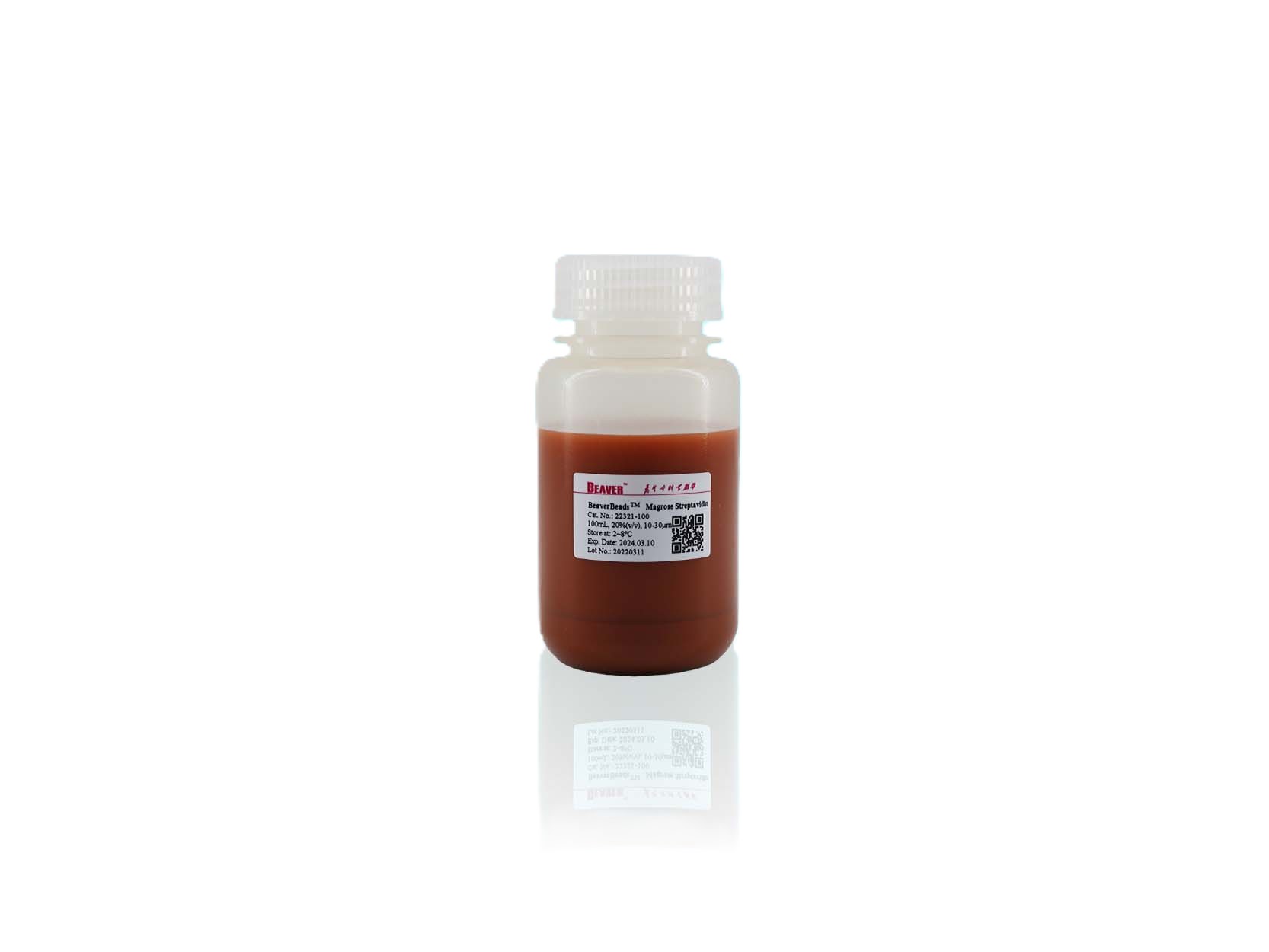
| Product Name | Streptavidin (10-30 µm) |
| Catalog No. | SM-HMM-0027 |
| Description | The Streptavidin Coated Beads, based on superparamagnetic or non-magnetic beads covalently coated with streptavidin, are designed to bind a variety of biotinylated molecules in immunoprecipitation, immunoassay(ELISA), cell sorting, protein interaction studies, protein/DNA hybridization reaction or even DNA sequencing application. |
| Storage | Stable at 2-8°C (can be stored or transported at room temperature for short periods of time) |
| Shelf Life | 2 years |
| Average Particle Size | 10-30 µm |
| Shell | Agarose |
| Preservation Fluid | 1×PBS with 0.1% (W/V) BSA, 0.1% (V/V) proclin-300 |
| Concentration | 20% (v/v) |
• Streptavidin is a tetrameric protein derived from Streptomyces avidinii, renowned for its exceptionally high affinity for biotin (Kd ≈ 10⁻¹⁴ M). This interaction is among the strongest non-covalent bonds in nature, making streptavidin-biotin systems indispensable in biotechnology and life science research.
• Originally isolated in the 1970s, streptavidin has since become a cornerstone of molecular biology applications, including immunoassays, protein purification, nucleic acid detection, and cellular imaging. Its stability under extreme conditions (e.g., high temperatures, denaturants) further enhances its utility in diverse experimental workflows.
• The 10–30 µM concentration range of this product is optimized for applications requiring moderate to high binding capacity, such as solid-phase assays, surface plasmon resonance (SPR) studies, and microplate-based detection systems.
• Researchers frequently leverage streptavidin’s neutral isoelectric point (pI ≈ 5–6) to minimize nonspecific interactions in complex biological matrices, ensuring higher specificity in assays like ELISA, flow cytometry, and lateral flow tests.
• Ultra-High Affinity: Binds biotin with a dissociation constant (Kd) of approximately 10⁻¹⁴ M, enabling irreversible capture of biotinylated molecules even under stringent conditions.
• Thermal Stability: Retains structural integrity up to 80°C, allowing repeated use in heating/cooling cycles without significant activity loss.
• Chemical Resistance: Resistant to detergents (e.g., SDS, Triton X-100), organic solvents, and chaotropic agents, ensuring compatibility with harsh purification protocols.
• Low Non-Specific Binding: Neutral surface charge reduces interactions with non-biotinylated proteins, enhancing signal-to-noise ratios in sensitive assays.
• Versatile Conjugation: Easily modified with fluorescent dyes, enzymes, or magnetic beads via primary amine groups, enabling customization for multiplexed detection or separation workflows.
• Cost-Effective: High binding capacity per unit reduces reagent consumption, lowering long-term experimental costs.
• Time-Efficient: Rapid binding kinetics (association rate constant, ka ≈ 10⁷ M⁻¹s⁻¹) shorten assay development and optimization timelines.
• Scalability: Compatible with both manual and automated high-throughput systems, supporting applications from benchtop research to industrial-scale bioprocessing.
• Long Shelf Life: Lyophilized formulation maintains stability for ≥24 months when stored at 2–8°C, minimizing waste and ensuring reproducibility.
For research use only, not for clinical use.
|
There is no product in your cart. |
Copyright © 2026 Alta DiagnoTech. All rights reserved.