Unveiling the Secrets of SARS-CoV-2: A Deep Dive into Deep Mutational Scanning

Unveiling the Secrets of SARS-CoV-2: A Deep Dive into Deep Mutational Scanning

The COVID-19 pandemic, triggered by the novel coronavirus SARS-CoV-2, has posed unparalleled challenges to global public health systems. Millions of lives have been directly impacted, while economies worldwide have faced significant disruptions. In the face of such a crisis, the urgent need for effective diagnostics, therapeutics, and vaccines quickly became evident. At the heart of these efforts was the necessity to deeply understand the virus's biology, especially its proteins, which are crucial for infection, replication, and immune evasion. These proteins not only facilitate the virus's entry into host cells but also enable it to evade the host's immune system, making the development of countermeasures particularly complex. As a result, researchers and scientists have been working tirelessly to decode the virus's genetic makeup, identify potential targets for intervention, and develop innovative strategies to combat its spread and mitigate its impact on human health.

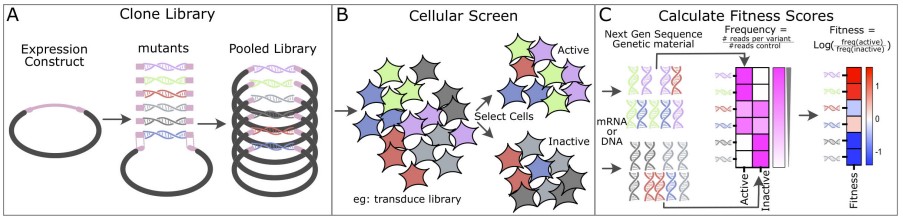
Schematic overview of the deep mutational scanning pipeline.Fig.1 Overview of deep mutational scanning workflow. (Call M. J., et al., 2025)

Understanding Deep Mutational Scanning (DMS)

  • Definition and Principles of DMS
    Deep Mutational Scanning (DMS) is a state-of-the-art, high-throughput experimental technique that has revolutionized the study of protein function and evolution. By leveraging next-generation sequencing (NGS), DMS systematically evaluates the functional consequences of thousands of amino acid substitutions within a protein of interest. This approach offers a comprehensive and detailed understanding of how each possible amino acid change impacts protein function, structure, and stability.
    Traditional mutagenesis methods typically focus on a limited number of mutations, often guided by specific hypotheses or known functional regions. In contrast, DMS provides an unbiased, holistic view of the entire protein sequence space. It enables researchers to identify critical residues for protein function, map functional landscapes, and uncover the underlying principles of protein evolution and adaptation. This technique is particularly valuable for studying proteins involved in complex biological processes, such as viral infection, enzyme catalysis, and protein-protein interactions.
  • DMS Workflow
    The DMS workflow is a multi-step process that integrates molecular biology, biochemistry, and computational analysis. Each step is crucial for generating meaningful insights into protein function and mutational effects.

    Library Construction

    The first step in DMS is the generation of a pooled library of protein variants. This is typically achieved using degenerate primers or DNA fragments containing random codons. These tools introduce a diverse array of mutations across the entire protein-coding sequence, creating a library that encompasses thousands to millions of unique protein variants. The goal is to create a comprehensive representation of all possible amino acid substitutions at each position in the protein.

    The library is then cloned into an appropriate expression vector, ensuring that each variant can be expressed in a cellular system. This step requires careful design to ensure high fidelity and diversity in the mutational spectrum.

    Expression in Cellular Systems

    The variant library is introduced into cells, which can be either eukaryotic (such as yeast or mammalian cells) or prokaryotic (such as bacteria). The method of introduction can vary, including viral transduction, transformation, or transfection, depending on the host system and the specific requirements of the experiment.

    Once inside the cells, the protein variants are expressed, allowing the functional consequences of each mutation to be assessed in a biological context. This step is critical because it enables the evaluation of protein function within the complex environment of a living cell, where interactions with other cellular components and regulatory mechanisms can influence the outcome.

    Functional Assays

    After expression, the cells are subjected to functional assays designed to measure specific protein functions. These assays can vary widely depending on the protein of interest and the research question being addressed. Common assays include:

    Enzymatic Activity Assays: Measuring the catalytic efficiency or substrate specificity of enzyme variants.

    Binding Affinity Assays: Evaluating the ability of protein variants to bind specific ligands, substrates, or other proteins.

    Cell Growth Assays: Assessing the impact of mutations on cell viability, proliferation, or other growth-related phenotypes.

    The choice of assay is crucial, as it determines the functional readout and the type of data generated. The assays must be carefully optimized to ensure that they accurately reflect the functional consequences of the mutations.


    NGS and Data Analysis

    Following the functional assays, DNA or mRNA is recovered from selected populations of cells. This genetic material is then prepared for next-generation sequencing (NGS). The sequencing process generates a large dataset of reads, which are aligned to the reference protein sequence to identify the specific mutations present in each variant.

    The read counts for each variant are converted into frequencies, reflecting the relative abundance of each mutant in the population. A log ratio is then calculated to define a fitness score for each variant. This score quantifies the impact of each mutation on protein function, with higher scores indicating better function and lower scores indicating reduced or lost function.

    Advanced computational tools and statistical methods are used to analyze the data, identify significant mutational effects, and generate functional maps of the protein. These maps provide a visual representation of the functional landscape, highlighting critical residues, functional domains, and regions of the protein that are more tolerant to mutations.

Application of DMS to SARS-CoV-2 Proteins

Spike Protein: The Gateway to Infection

  • Structure and Function
    The spike protein is a large (1273 amino acids) trimeric structure on the surface of SARS-CoV-2. Its receptor-binding domain (RBD) directly interacts with the human angiotensin-converting enzyme 2 (ACE2), initiating host cell invasion. Blocking this interaction with anti-RBD antibodies can confer sterilizing immunity.
  • DMS Studies on RBD
    Early DMS studies focused on the RBD, screening over 100,000 variants with high coverage of single-site substitutions. These studies mapped the structural landscape of the RBD, highlighting residues critical for ACE2 binding and immune evasion. For instance, mutations like N501Y, Q498H, and Y453F were identified as strong enhancers of ACE2 binding, with N501Y becoming a defining feature of circulating variants.
  • Full-Length Spike Protein Analysis
    Beyond the RBD, DMS has been used to analyze the full-length spike protein. Techniques like pseudotyped lentiviral models have assessed the overall ability of the spike to mediate viral entry into cells. These studies revealed that mutations in the spike protein can modulate the equilibrium between open (ACE2-binding) and closed (non-binding) forms, affecting infectivity and susceptibility to antibody neutralization.
  • SARS-CoV-2 Proteases: Mpro and PLpro

    Role of Proteases in Viral Replication

    Proteases are essential for viral replication, processing the viral polyproteins into functional units. SARS-CoV-2 encodes two main proteases: main protease (Mpro) and papain-like protease (PLpro). Mpro processes 11 of the 16 non-structural proteins (nsps), while PLpro releases nsp1 and nsp2 and deconjugates ubiquitin and ISG15 from host and viral proteins.

    DMS on Mpro

    DMS screens on Mpro have identified residues critical for its dimerization, catalytic activity, and substrate binding. These studies revealed that mutations at the dimer interface and active site can significantly reduce proteolytic activity, making them potential targets for antiviral drugs. For instance, mutations like E166V and L50F have been shown to confer resistance to Mpro inhibitors like nirmatrelvir and ensitrelvir.

    DMS on PLpro

    Similarly, DMS on PLpro has mapped its functional substitutions, identifying a network of residues that govern catalytic activity and drug resistance. The shallow active site of PLpro makes it challenging to target directly, but DMS has highlighted potential allosteric sites and vulnerabilities, such as the non-conserved blocking loop lining the S4 pocket.

Nucleocapsid Protein: Implications for Rapid Antigen Testing

  • Role of Nucleocapsid in Viral Assembly
    The nucleocapsid (N) protein condenses the viral RNA genome and plays a crucial role in viral assembly. Mutations in the N protein can affect its binding to antibodies used in rapid antigen tests, leading to false-negative results.
  • DMS Studies on N Protein
    DMS has been used to pre-emptively determine mutations in the N protein that could escape detection by antibodies used in commercial test kits. These studies revealed common binding epitopes across different antibodies, suggesting that mutations in these regions could affect multiple test kits. Coupling DMS with surveillance efforts can ensure the accuracy of rapid antigen testing, enhancing public health responses.

Impact of DMS on Therapeutic Development

  • Impact of DMS on Therapeutic Development
    Deep Mutational Scanning (DMS) has emerged as a powerful tool in the field of therapeutic development, particularly in the context of infectious diseases and viral pathogens. Its ability to systematically evaluate the functional consequences of mutations across entire proteins has provided critical insights that have accelerated the development of vaccines, therapeutic antibodies, and antiviral inhibitors.
  • Vaccine Design
    One of the most significant contributions of DMS has been in the realm of vaccine development, especially for viruses like SARS-CoV-2. By mapping the epitopes on viral proteins that are targeted by neutralizing antibodies, DMS has enabled researchers to design vaccines that elicit broad and robust immune responses. For instance, DMS studies have identified key regions on the spike protein of SARS-CoV-2 that are critical for antibody binding. This information has been instrumental in the development of mRNA vaccines like mRNA-1273, which have been shown to induce a broader epitope coverage compared to natural infection. This broader coverage significantly reduces the risk of escape mutants, ensuring that the vaccine remains effective against emerging variants.
    Moreover, DMS has facilitated the design of next-generation vaccines that incorporate multiple epitopes or conserved regions of the virus. By identifying regions that are less likely to mutate without compromising viral fitness, researchers can create vaccines that target these conserved sites, thereby enhancing long-term efficacy and durability against evolving strains.
  • Therapeutic Antibodies
    DMS has also played a crucial role in the development of therapeutic antibodies, which are essential for treating viral infections and other diseases. By conducting epitope mapping, DMS allows researchers to identify antibodies that target different regions of viral proteins, such as the spike protein of SARS-CoV-2. This approach ensures comprehensive protection by targeting multiple epitopes simultaneously. For example, combining antibodies that target distinct epitopes can limit the virus's ability to accumulate mutations that evade all constituent antibodies. This strategy has been particularly effective in the development of antibody cocktails, which provide robust protection against viral escape mutants.
    Furthermore, DMS helps in understanding the structural and functional basis of antibody binding. By identifying the critical residues within epitopes, researchers can optimize the binding affinity and specificity of therapeutic antibodies. This optimization not only enhances the efficacy of the antibodies but also reduces the likelihood of resistance development, making them more effective in clinical settings.
  • Antiviral Inhibitors
    In addition to vaccines and antibodies, DMS has significantly impacted the development of antiviral inhibitors. For instance, DMS has been used to study viral proteases, which are essential for viral replication and are common targets for antiviral drugs. By identifying residues that are critical for protease function and drug binding, DMS has guided the design of inhibitors that are less susceptible to resistance mutations.
    A prime example is the development of Mpro inhibitors like nirmatrelvir and ensitrelvir. DMS studies have highlighted potential resistance pathways by identifying mutations that could compromise drug efficacy. This information has been invaluable in designing inhibitors that target conserved regions of the protease, thereby reducing the likelihood of resistance. Moreover, DMS has enabled researchers to predict and preemptively address potential resistance mutations, ensuring that the antiviral inhibitors remain effective against evolving viral strains.
  • Broader Implications and Future Directions
    The impact of DMS on therapeutic development extends beyond the examples mentioned above. Its applications are also relevant in the development of treatments for other infectious diseases, cancer, and autoimmune disorders. By providing a detailed understanding of protein function and mutational landscapes, DMS enables the rational design of therapeutics that are more effective, durable, and less prone to resistance.
    As technology continues to advance, the integration of DMS with other high-throughput techniques and computational modeling will further enhance its capabilities. For instance, combining DMS with cryo-electron microscopy (cryo-EM) can provide structural insights into protein-ligand interactions, while machine learning algorithms can analyze DMS data to predict the functional consequences of mutations with even greater accuracy.

If you have related needs, please feel free to contact us for more information or product support.

Reference

  1. Call, Melissa J., Matthew E. Call, and Xinyu Wu. "Insights from deep mutational scanning in the context of an emerging pathogen." Biochemical Society Transactions 53.05 (2025): 1169-1179.

This article is for research use only. Do not use in any diagnostic or therapeutic application.

Get in Touch
0
0

There is no product in your cart.