Unlocking the Mysteries of Serological Diagnostics: A Comprehensive Guide to Validation and Quality Assurance
Serological diagnostics have become indispensable tools in modern healthcare, enabling the detection of antibodies and antigens in biological samples. These tests are pivotal in diagnosing infectious diseases, autoimmune disorders, and even chronic conditions like cancer. The accuracy and reliability of serological diagnostics hinge on rigorous validation and quality assurance processes. This comprehensive guide delves into the intricacies of validating serological assays, ensuring their performance meets the highest standards of precision and reliability.
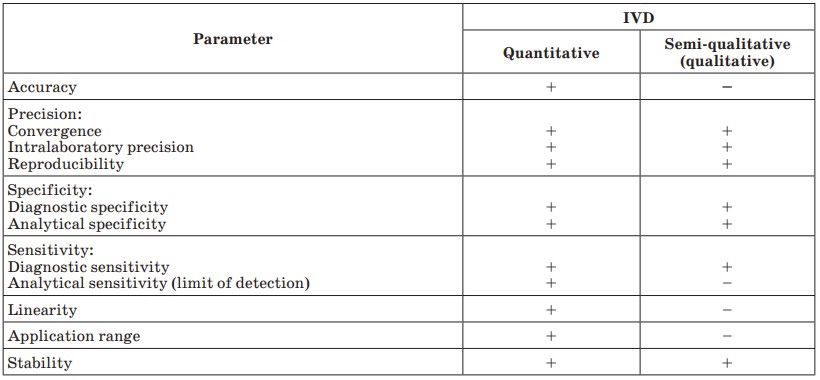 Fig.1 Validation parameters for different kinds of IVD. (Galkin O. Y., et al., 2018)
The Fundamentals of Serological Assays
Principles of Serological Testing
Serological assays rely on the interaction between antibodies and antigens. When a pathogen invades the body, the immune system produces specific antibodies to neutralize it. Serological tests detect these antibodies or the antigens themselves in blood, serum, or other bodily fluids. The most common types of serological assays include enzyme-linked immunosorbent assays (ELISAs), lateral flow assays (LFAs), and chemiluminescent immunoassays (CLIAs).
Key Components of Serological Assays
- Antigens: Molecules that trigger an immune response. In serological diagnostics, antigens are often proteins or polysaccharides derived from pathogens.
- Antibodies: Proteins produced by the immune system to recognize and neutralize antigens. Primary antibodies bind directly to the target antigen, while secondary antibodies amplify the signal.
- Enzymes and Labels: Enzymes like horseradish peroxidase (HRP) or alkaline phosphatase (AP) are conjugated to antibodies to produce a detectable signal, often a color change or fluorescence.
Validation of Serological Assays: A Step-by-Step Approach
Pre-Analytical Validation
- Sample Collection and Handling
The quality of serological test results begins with proper sample collection and handling. Factors such as the type of container, storage temperature, and time between collection and testing can significantly impact assay performance. For instance, hemolysis (rupture of red blood cells) can release intracellular components that interfere with antibody-antigen binding, leading to false positives or negatives.
Example: A study comparing serum samples stored at -20°C versus 4°C found that samples stored at 4°C showed a 15% decrease in antibody titer over three months, highlighting the importance of proper storage conditions.
- Selection of Controls
Controls are essential for validating the accuracy and precision of serological assays. Positive and negative controls should mimic the test samples in matrix composition and concentration. Internal controls, such as housekeeping genes in molecular assays, ensure that the assay is functioning correctly.
Table 1: Types of Controls in Serological Assays.
| Control Type |
Purpose |
Example |
| Positive Control |
Validates assay sensitivity |
Known antibody-positive serum |
| Negative Control |
Validates assay specificity |
Antibody-negative serum |
| Internal Control |
Monitors assay consistency |
Housekeeping protein in ELISA |
Sensitivity and Specificity
Sensitivity measures the assay's ability to correctly identify true positives, while specificity measures its ability to correctly identify true negatives. High sensitivity is crucial for detecting low-titer antibodies in early-stage infections, whereas high specificity minimizes false positives, which can lead to unnecessary treatments or quarantines.
Example: In a study evaluating an ELISA for detecting antibodies against SARS-CoV-2, the assay demonstrated 98% sensitivity and 99% specificity, making it highly reliable for diagnostic purposes.
Precision and Reproducibility
Precision refers to the assay's ability to produce consistent results under the same conditions. Reproducibility assesses whether the assay yields similar results across different laboratories or operators. Both are critical for ensuring that serological tests provide reliable data in clinical settings.
Method: To evaluate precision, run the same sample multiple times (intra-assay precision) and across different days or operators (inter-assay precision). Calculate the coefficient of variation (CV) to quantify variability.
Limit of Detection (LoD) and Limit of Quantitation (LoQ)
The LoD is the lowest concentration of an analyte that can be reliably detected, while the LoQ is the lowest concentration that can be quantitatively determined with acceptable precision and accuracy. Determining these limits ensures that the assay can detect clinically relevant levels of antibodies or antigens.
Example: For an HIV antibody test, the LoD might be set at 0.1 IU/mL, ensuring that even low levels of antibodies are detected, which is critical for early diagnosis.
Post-Analytical Validation
- Data Interpretation and Reporting
Clear guidelines for interpreting test results are essential to avoid misdiagnosis. Cutoff values, which distinguish positive from negative results, should be established based on clinical relevance and statistical analysis.
Example: In a rapid diagnostic test for dengue fever, a cutoff optical density (OD) value of 0.5 was established, with samples above this value considered positive. This cutoff was validated through receiver operating characteristic (ROC) curve analysis.
- Clinical Validation
Clinical validation ensures that the assay's performance translates to real-world patient outcomes. This involves comparing the assay's results with a gold standard test or clinical diagnosis.
Study: A clinical validation study for a new LFA for malaria compared its results with microscopic examination of blood smears. The LFA demonstrated 95% agreement with microscopy, confirming its clinical utility.
Quality Assurance in Serological Diagnostics
Good Manufacturing Practices (GMP)
GMP compliance is mandatory for manufacturing serological diagnostic kits. GMP ensures that products are consistently produced and controlled according to quality standards. Key aspects include:
- Facility Design: Cleanrooms with controlled temperature, humidity, and air quality.
- Equipment Calibration: Regular calibration and maintenance of instruments to ensure accuracy.
- Personnel Training: Ongoing training for staff on GMP principles and assay-specific procedures.
Quality Control (QC) Materials
QC materials are used to monitor the performance of serological assays during production and after release. These include:
- Positive and Negative QC Panels: Verifies assay sensitivity and specificity.
- Stability QC: Assesses the long-term stability of reagents and kits.
- Precision QC: Evaluates intra- and inter-assay variability.
Table 2: Types of QC Materials in Serological Diagnostics.
| QC Material Type |
Purpose |
Frequency of Use |
| Positive QC |
Validates sensitivity |
Daily |
| Negative QC |
Validates specificity |
Daily |
| Stability QC |
Monitors reagent stability |
Monthly |
| Precision QC |
Assesses reproducibility |
Quarterly |
Regulatory Compliance
Serological diagnostic kits must comply with international and national regulations, such as the FDA (U.S.), CE (Europe), and local health authorities. Compliance involves:
- Pre-Market Approval: Submitting data on assay performance, safety, and efficacy.
- Post-Market Surveillance: Monitoring adverse events and product performance after release.
- Labeling and Instructions for Use (IFU): Providing clear, accurate information on assay limitations and interpretation.
Emerging Trends and Future Directions
- Multiplex Assays
Multiplex serological assays can simultaneously detect multiple antibodies or antigens in a single sample, improving efficiency and reducing costs. These assays are particularly useful for screening large populations or monitoring immune responses to multiple pathogens.
Example: A multiplex bead-based assay can detect antibodies against influenza A, B, and respiratory syncytial virus (RSV) in a single test, providing comprehensive diagnostic information.
- Point-of-Care Testing (POCT)
POCT devices enable rapid, on-site serological testing, which is crucial for outbreak response and resource-limited settings. Advances in microfluidics and nanotechnology have led to the development of portable, user-friendly POCT devices with high sensitivity and specificity.
Case Study: During the COVID-19 pandemic, POCT devices for detecting SARS-CoV-2 antibodies played a vital role in contact tracing and infection control.
- Artificial Intelligence (AI) in Serological Diagnostics
AI algorithms can analyze large datasets from serological assays to identify patterns and predict outcomes. Machine learning models can optimize assay conditions, improve data interpretation, and even predict disease progression based on antibody profiles.
Application: AI-powered platforms can analyze ELISA data to distinguish between true positives and false positives, reducing diagnostic errors.
If you have related needs, please feel free to contact us for more information or product support.
Reference
- Galkin, O. Yu, A. G. Komar, and M. O. Pys' Menna. "Specificity of manufacturing process validation for diagnostic serological devices." Biotechnologia Acta 11.1 (2018): 25-38.
This article is for research use only. Do not use in any diagnostic or therapeutic application.