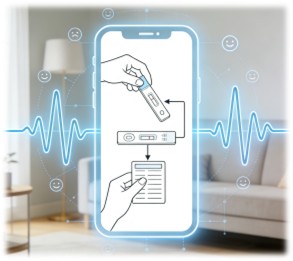
Prenatal care is a cornerstone of maternal and fetal health, playing a crucial role in ensuring the well-being of both the mother and the developing fetus. It is designed to provide comprehensive medical support throughout pregnancy, facilitating early detection and management of potential complications. Regular check-ups, screenings, and assessments are essential components of prenatal care, allowing healthcare providers to monitor the progress of the pregnancy and address any issues promptly. One vital aspect of prenatal care is regular urinalysis, which serves as a critical diagnostic tool. Urinalysis helps identify a range of conditions that can impact pregnancy outcomes, such as urinary tract infections (UTIs), gestational diabetes, and preeclampsia. Early detection of these conditions is crucial for timely intervention, reducing the risk of complications and ensuring a healthier pregnancy journey. Traditional urinalysis methods typically involve healthcare professionals visually interpreting test strips that change color based on the presence of specific substances in the urine. While this method has been widely used, it is not without its limitations. The process is time-consuming, requiring healthcare providers to manually read and interpret the color changes on the strips. Additionally, visual interpretation is prone to human error, which can lead to inaccurate results and potential misdiagnoses. These limitations highlight the need for a more efficient and reliable method for prenatal urinalysis.
Enter smartphone-based colorimetric analysis—a groundbreaking innovation that leverages the ubiquitous presence of smartphones to transform at-home prenatal urinalysis. This cutting-edge technology promises to revolutionize prenatal care by making it more accessible, efficient, and accurate. By enabling patients to perform urinalysis from the comfort of their homes, this innovation addresses many of the limitations associated with traditional methods. Using a smartphone's camera and a specialized app, patients can capture images of the test strips and receive automated, accurate readings within minutes. This eliminates the need for manual interpretation, reducing the risk of human error and providing faster results. Smartphone-based colorimetric analysis not only enhances the accuracy of urinalysis but also empowers patients to take a more active role in their prenatal care. With the ability to perform tests at home, expectant mothers can monitor their health more frequently and conveniently, ensuring that any potential issues are detected early. This technology can also help reduce the burden on healthcare facilities, allowing for more efficient use of resources and ensuring that critical care is prioritized for those who need it most.
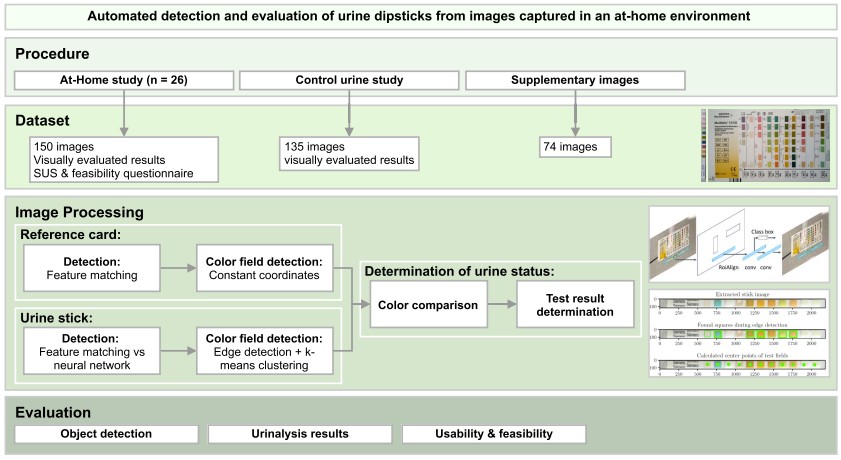 Fig.1 Overview diagram describing the pipeline of the automated detection and evaluation of urine test strips, including the conducted studies, the resulting dataset and further image processing. (Flaucher M., et al., 2022)
The Science Behind Colorimetric Analysis
Colorimetric analysis is a widely used, reliable analytical method for determining the concentration of a specific substance (analyte) in a solution. It works by measuring the color change of a specialized reagent when it chemically reacts with the target analyte. This technique is grounded in the fundamental principle that many chemical reactions between analytes and reagents produce a distinct, visible color change—and this color change can be quantitatively measured to determine how much of the analyte is present.
In the context of urinalysis, which is a common clinical application, test strips are carefully impregnated with specific reagents tailored to react with particular substances commonly found in urine. These substances include glucose, proteins, leukocytes, ketones, and bilirubin, among others. When the urine sample comes into contact with these reagents, a color change occurs, and crucially, this color change is directly proportional to the concentration of the target analytes in the urine. This proportional relationship makes colorimetric analysis an efficient, cost-effective, and powerful tool for detecting and quantifying various key health indicators, supporting rapid preliminary diagnosis in clinical settings.
The process of colorimetric urinalysis is straightforward and user-friendly, making it suitable for both clinical laboratories and point-of-care testing. It begins with collecting a fresh urine sample, which is then carefully applied to the designated areas of the test strip. Once the sample comes into contact with the reagents on the strip, a chemical reaction is triggered, leading to a visible color change that can be observed with the naked eye. For example, a reagent designed to detect glucose might initially be blue and turn progressively darker brown as the concentration of glucose in the urine increases—the intensity of the brown color directly correlates to how much glucose is present in the sample.
Similarly, reagents formulated to detect proteins or leukocytes will undergo specific color transformations based on both the presence and concentration of these analytes. For instance, a protein-detecting reagent may change from yellow to green or blue, with deeper hues indicating higher protein levels, which can be a sign of kidney-related issues. Leukocyte-detecting reagents, on the other hand, might shift from white to purple, signaling the presence of infection-fighting cells in the urine.
Smartphone-Based Colorimetric Analysis
Smartphone-based colorimetric analysis takes this traditional colorimetric testing method to a new level of precision, accessibility, and practicality. By fully leveraging the high-resolution built-in cameras and powerful on-board processing capabilities of modern smartphones—devices that are now ubiquitous in daily life—this innovative technology captures clear, detailed images of test strips immediately after they have reacted with a urine sample. Advanced, custom-developed image processing algorithms then meticulously analyze the subtle color changes in these images, cross-referencing them against a pre-established, calibrated reference database to accurately determine the concentration of target analytes with high reliability.
The image processing algorithms utilized in smartphone-based colorimetric analysis are highly sophisticated and specifically designed to account for common variations in real-world conditions. These include fluctuations in ambient lighting (such as natural daylight versus artificial indoor light), slight differences in camera angles during image capture, and other minor environmental factors that could otherwise compromise the accuracy of test readings. To mitigate these issues, the algorithms convert the captured RGB or HSL color data from images into standardized, consistent color values. These standardized values are then compared against a detailed calibrated reference database, which contains pre-determined color standards for a wide range of analyte concentrations. This rigorous comparison process enables the system to deliver precise, quantitative results that are comparable to those from traditional laboratory-grade colorimetric equipment, while maintaining the convenience of on-the-go testing.
Development of the Smartphone-Based Urinalysis Pipeline
The development of a smartphone-based urinalysis pipeline involves several key steps: image acquisition, preprocessing, object detection, color comparison, and result interpretation.
Image Acquisition and Preprocessing
To ensure accurate analysis, high-quality images of the test strips must be captured. This involves controlling lighting conditions, minimizing background noise, and ensuring the test strip is properly aligned within the frame. Preprocessing steps, such as noise reduction, contrast enhancement, and color correction, are then applied to improve image quality.
Object Detection and Localization
Object detection algorithms are used to identify the test strip and reference card within the image. This is crucial for accurately localizing the test fields and reference fields for subsequent color comparison. Techniques such as feature matching and region-based convolutional neural networks (R-CNNs) have shown promise in this regard.
- Feature Matching: This method involves identifying key points and descriptors in both the test strip and reference card images and then matching these points to determine their relative positions.
- Region-Based Convolutional Neural Networks (R-CNNs): R-CNNs are deep learning models that can detect and localize objects within images with high accuracy. They are trained on annotated datasets to recognize specific patterns and shapes associated with test strips and reference cards.
Color Comparison and Result Interpretation
Once the test fields and reference fields have been localized, color comparison algorithms are used to determine the concentration of the analytes. Three primary methods are employed:
- Hue Channel Comparison: The hue channel in the HSV color space represents the dominant wavelength of the color and is used to compare the test field's color to the reference field's color.
- Matching Factor: This method incorporates weighted values of the hue, saturation, and value (HSV) channels to calculate a similarity score between the test field and reference field.
- Euclidean Distance: The Euclidean distance between the color vectors of the test field and reference field in the HSV color space is calculated to determine their similarity.
The results of these comparisons are then interpreted to determine the presence and concentration of specific analytes in the urine sample.
Validation and Performance Evaluation
To validate the accuracy and reliability of the smartphone-based urinalysis pipeline, extensive testing was conducted using both healthy participants and control urine samples with known concentrations of analytes.
At-Home Study with Healthy Participants
In the at-home study, 26 participants (half male, half female) conducted urinalysis using a test kit containing two test strips, a reference card, and a plastic cup. A web application was provided to guide users through the process, ensuring consistent image acquisition and documentation.
The results showed that the majority of participants were able to successfully capture and analyze images of the test strips using their smartphones. However, some participants reported insecurity regarding the visual determination of test results, highlighting the need for user-friendly interfaces and clear instructions.
Control Urine Study
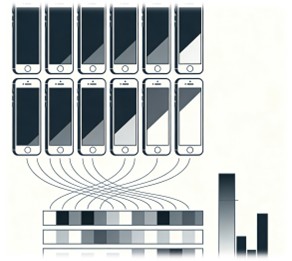
To further validate the pipeline's accuracy, a control urine study was conducted using manufactured urine samples with known concentrations of analytes. Twelve different smartphones were used to capture images of the test strips after they had reacted with the control urine.
The results demonstrated high accuracy in detecting and quantifying the analytes, with an average F1-score of 0.81 for the hue channel comparison method. The matching factor and Euclidean distance methods also showed promising results, with average F1-scores of 0.80 and 0.70, respectively.
Clinical Impact and Future Directions
The integration of smartphone-based colorimetric analysis into routine prenatal care holds significant potential to revolutionize the traditional approach to urinalysis in maternal health. By enabling convenient, non-invasive at-home testing for expectant mothers, this technology allows patients to reduce the frequency of in-person clinic appointments, thereby enhancing overall convenience, saving time, and contributing to reduced healthcare costs for both patients and medical facilities.
Moreover, the full automation of the urinalysis analysis process effectively eliminates observer-related errors that often arise from manual interpretation of test strips, which in turn increases the accuracy and reliability of test results. This advancement not only ensures more precise monitoring of maternal health during pregnancy but also has the potential to alleviate the workload burden on healthcare systems by reducing the need for trained personnel to manually read and interpret test strip results.
- Expansion to Other Medical Areas
While the current research and application focus is primarily on prenatal care, smartphone-based colorimetric analysis is highly versatile and has promising applications in various other medical fields. Chronic disease management (such as diabetes and kidney disease, where regular urinalysis is critical), elderly care (enabling remote health monitoring for seniors with limited mobility), and telemedicine services are just a few key examples where remote, smartphone-enabled urinalysis could significantly enhance patient monitoring efficiency and ultimately improve long-term health outcomes.
- Continuous Improvement and Validation
To facilitate the widespread clinical adoption of smartphone-based urinalysis technology, continuous improvement and rigorous scientific validation are essential steps. This process includes expanding the existing dataset to cover a wider range of analyte concentrations and variations, optimizing the image processing algorithms to ensure compatibility and accuracy across different smartphone models and camera specifications, and conducting larger-scale, long-term clinical trials involving diverse patient populations to further validate the technology's accuracy, reliability, and clinical utility.
Conclusion
Smartphone-based colorimetric analysis represents a significant advancement in at-home prenatal urinalysis, filling a critical gap in the accessibility and convenience of prenatal care for expectant parents worldwide. Unlike traditional urinalysis methods that require frequent visits to clinics, lab tests, and long waiting times for results, this innovative approach leverages the universal availability of smartphones and sophisticated image processing algorithms to deliver reliable, real-time insights into key prenatal health indicators—all from the comfort of one's home. By turning a common personal device into a portable diagnostic tool, it eliminates barriers such as geographical distance, time constraints, and high healthcare costs that often prevent timely prenatal monitoring, especially for individuals in remote areas or with limited access to medical facilities.
This technology not only enhances accessibility but also promises to make prenatal care more efficient and accurate. The advanced image processing algorithms integrated into smartphone-based systems are designed to precisely detect and quantify color changes in urinalysis test strips, minimizing the human error associated with manual visual interpretation. This level of precision ensures that potential abnormalities, such as irregular levels of protein, glucose, or ketones—key markers of conditions like preeclampsia or gestational diabetes—are identified early, allowing for prompt medical intervention and improved health outcomes for both mothers and babies. Moreover, the digital nature of this solution enables seamless storage and sharing of test results with healthcare providers, facilitating more informed, personalized prenatal care plans and fostering better communication between patients and clinicians.
As we move towards a more digital future in healthcare, innovations like smartphone-based urinalysis will play an increasingly crucial role in transforming the way we diagnose and manage health conditions, particularly in the realm of prenatal care. This technology aligns with the global shift towards patient-centered care, empowering expectant parents to take a more active role in monitoring their health throughout pregnancy. With ongoing advancements in smartphone technology, artificial intelligence, and colorimetric detection methods, the potential for further improvements—such as expanded test capabilities, enhanced accuracy, and integration with broader digital health platforms—continues to grow. In the long run, smartphone-based colorimetric analysis is poised to become an indispensable tool in prenatal care, revolutionizing accessibility, efficiency, and quality of care for millions of expectant families around the globe.
If you have related needs, please feel free to contact us for more information or product support.
Reference
- Flaucher, Madeleine, et al. "Smartphone-based colorimetric analysis of urine test strips for at-home prenatal care." IEEE Journal of Translational Engineering in Health and Medicine 10 (2022): 1-9.
Urinalysis
| Cat.No |
Product Name |
Price |
| UU-0096 |
Urine analysis test strips, dry chemical method |
Add To Cart
|
| UU-0097 |
Urine analysis test strips (leukocytes, nitrite, urobilinogen, protein, pH, occult blood, specific gravity, ketone bodies, bilirubin, glucose) |
Add To Cart
|
| UU-0098 |
Urine analysis test strips, PET |
Add To Cart
|
| UU-0099 |
Urine analysis test strips, polyethylene terephthalate |
Add To Cart
|
| UU-00100 |
Polyethylene terephthalate-based urine analysis test strips |
Add To Cart
|
| UU-00101 |
Urine analysis test strips, 1 kg |
Add To Cart
|
This article is for research use only. Do not use in any diagnostic or therapeutic application.