As the world advances toward global polio eradication, reliable laboratory diagnostics remain critical for identifying outbreaks, distinguishing wild-type from vaccine-derived strains, and guiding public health action. This comprehensive resource outlines the complete diagnostic workflow, from clinical suspicion to confirmatory testing, and explores gold-standard methods for optimizing accuracy.
Introduction to Poliomyelitis
Poliomyelitis, commonly called polio, is a highly infectious viral disease caused by the poliovirus (serotypes 1, 2, or 3), which primarily targets the nervous system and can lead to irreversible paralysis. While global vaccination efforts have nearly eradicated wild poliovirus, challenges persist with vaccine-derived strains (VDPVs) and outbreaks in underimmunized populations. Rapid and accurate laboratory diagnosis is critical for surveillance, outbreak containment, and maintaining polio-free status.
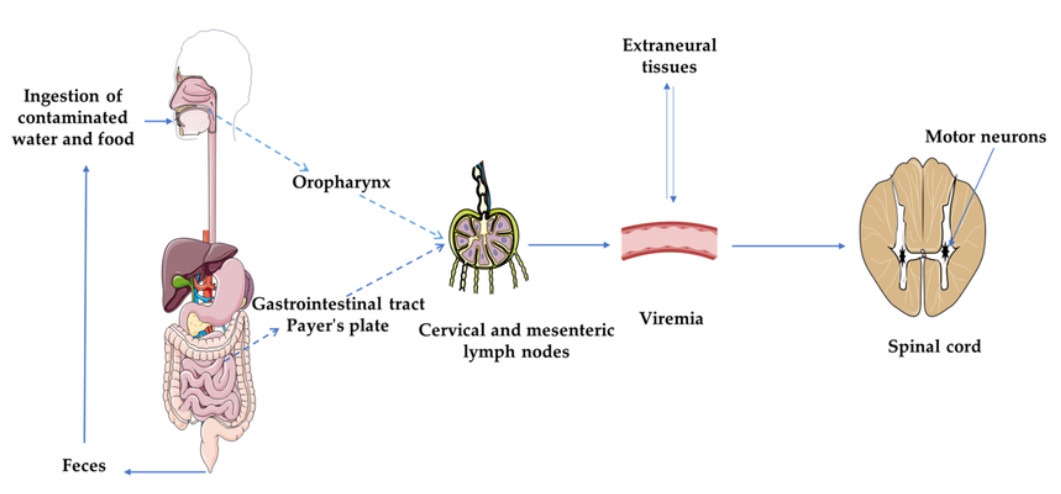 Fig.1 Pathogenesis of poliomyelitis. (Mbani C J, et al., 2023)
Diagnostic Workflow for Poliomyelitis
An efficient and accurate diagnostic workflow is essential for detecting poliovirus, confirming cases, and supporting global eradication efforts. The process integrates clinical assessment, sample collection, and laboratory testing to ensure timely and reliable results. Here's a step-by-step breakdown:
1. Clinical Suspicion & Case Identification
Clinical suspicion and case identification form the foundation of polio surveillance and outbreak control, serving as the primary trigger for laboratory testing and public health action.
- Acute flaccid paralysis (AFP) surveillance: The primary trigger for polio testing, especially in endemic or high-risk regions.
- Epidemiological risk factors: Travel history, vaccination status, and community outbreaks.
2. Sample Collection & Handling
Preferred Specimens
- Stool samples (highest sensitivity; collect 2 samples, 24–48 hours apart).
- Cerebrospinal fluid (CSF) (for paralytic cases; detect IgM antibodies).
- Environmental samples (sewage testing for surveillance).
Critical Pre-analytical Steps
- Sample Storage & Transport: Maintain samples at 2–8°C (short-term) or -70°C (long-term) using viral transport media (VTM) to preserve poliovirus integrity during transit.
- Documentation & Labeling: Clearly label specimens with patient ID, collection date, and "Suspected Poliovirus" while recording vaccination history and exposure risks for traceability.
3. Laboratory Testing Methods
Screening
The initial screening for poliovirus relies on real-time RT-PCR, which detects viral RNA in stool, CSF, or environmental samples within hours, which is critical for rapid response to epidemics. This method targets conserved regions like the VP1 capsid protein or 5’ UTR, offering high sensitivity to rule out polio quickly. In resource-limited settings, antigen detection assays (e.g., ELISA) may serve as preliminary tools, though they are less sensitive than molecular methods. Screening prioritizes speed to trigger public health actions while minimizing unnecessary culture-based testing.
Confirmation & Strain Differentiation
Positive screening results require confirmation and strain discrimination to identify wild-type, vaccine (Sabin), or vaccine-derived poliovirus (VDPV). The gold standard is virus isolation in cell cultures (e.g., L20B or RD cells), though this takes 7–10 days. Faster alternatives include intratypic differentiation (ITD) RT-PCR, which distinguishes strains by genetic markers. For outbreaks, whole-genome sequencing is added to track transmission chains and identify mutations. These steps are vital for guiding vaccination strategies.
Serology
Serological tests (e.g., neutralization assays or ELISA) detect poliovirus-specific IgM (acute infection) or IgG (past exposure/vaccination). While less useful for early diagnosis (antibodies take days to weeks to develop), they aid in:
- Retrospective diagnosis of paralytic cases with negative PCR/culture.
- Vaccine efficacy studies (measuring antibody titers post-IPV/OPV).
- Serosurveillance in high-risk populations.
4. Reporting & Public Health Action
Timely and accurate reporting of poliovirus detection is critical for global surveillance and outbreak containment. Laboratories must immediately notify national health authorities and the WHO Global Polio Laboratory Network (GPLN) upon positive results, especially for vaccine-derived (VDPV) or wild-type strains. Public health responses include emergency vaccination campaigns (e.g., ring vaccination), enhanced environmental monitoring, and contact tracing. Genetic sequencing data, when available, helps track transmission chains and guide targeted interventions. This step ensures alignment with the Global Polio Eradication Initiative (GPEI), turning lab findings into actionable strategies to prevent resurgence.
Future of Poliomyelitis Diagnostics
The future of poliovirus diagnostics is shifting toward ultra-sensitive, decentralized, and genomic-enabled technologies to support the final phase of global eradication. Key innovations include:
- Portable molecular tools (e.g., nanopore sequencing) for field-deployable strain differentiation.
- AI-driven surveillance platforms integrating sewage testing, clinical data, and genomic epidemiology to predict outbreaks.
- Multiplex pan-enterovirus panels to distinguish polio from mimics (e.g., EV-D68) with a single test.
- Digital health integration, enabling real-time reporting to WHO networks via cloud-based systems.
Alta DiagnoTech delivers end-to-end poliomyelitis diagnostics solutions, offering high-precision test kits, cutting-edge detection instruments, and optimized consumables to support global eradication efforts. If you have related needs, please feel free to contact us for more information or product support.
Reference
- Mbani C J, Nekoua M P, Moukassa D, et al. The fight against poliovirus is not over[J]. Microorganisms, 2023, 11(5): 1323.
This article is for research use only. Do not use in any diagnostic or therapeutic application.