- Home
- Resource
- Explore & Learn
- Challenges and Breakthroughs in the Development of Diagnostic Monoclonal Antibodies
- Home
- IVD
- By Technology Types
- By Diseases Types
- By Product Types
- Research
- Resource
- Distributors
- Company
The landscape of in vitro diagnostics (IVD) is undergoing a seismic shift, driven by monumental advancements in monoclonal antibody (mAb) development. These highly specific molecules have become the cornerstone of modern diagnostic assays, enabling precise detection of biomarkers associated with various diseases. The journey of mAb development, from its nascent stages to the cutting-edge innovations of today, is a testament to human ingenuity and scientific progress. This article delves into the evolution, challenges, and breakthroughs in mAb development, shedding light on the future of diagnostics.
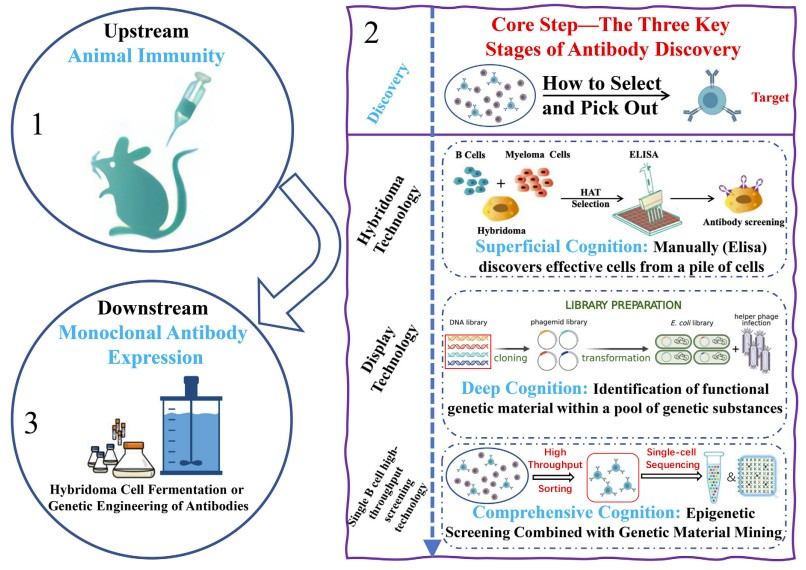
Fig.1 Three critical phases of antibody discovery: i) superficial cognition: manually (Elisa) discovers effective cells from a pile of cells; ii) deep cognition: identification of functional genetic material within a pool of genetic substances; iii) comprehensive cognition: epigenetic screening combined with genetic material mining. (Wang J., et al., 2024)

The Serum Era: Foundations of Humoral Immunity
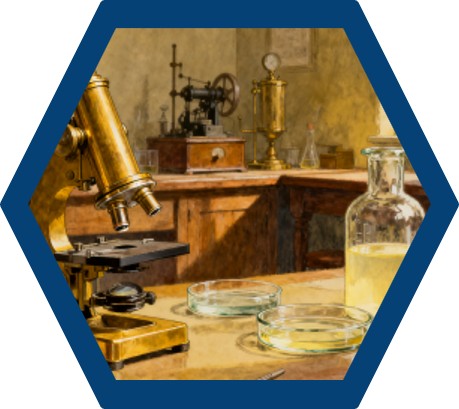
The story of antibody discovery begins in the late 19th century with the seminal work of Emil Adolf von Behring and Kitasato Shibasaburo. They demonstrated that serum from animals immunized with tetanus bacillus could protect other animals from the disease, marking the birth of antitoxin research and humoral immunity. This era laid the groundwork for understanding the immune system's ability to produce specific antibodies against pathogens.

Hybridoma Technology: A Quantum Leap
The advent of hybridoma technology in the 1970s revolutionized antibody production. Developed by Georges Köhler and César Milstein, this technique involved fusing antibody-producing B cells with immortal myeloma cells, creating hybrid cell lines capable of producing large quantities of monoclonal antibodies. This breakthrough enabled the production of highly specific and consistent antibodies, paving the way for widespread use in diagnostics and therapeutics.

Phage Display and Single B Cell Screening: Precision at Its Best
The exploration of genetic material for antibody discovery took center stage with the development of phage display technology in the 1980s. This technique allowed researchers to display antibody fragments on the surface of bacteriophages, facilitating the rapid identification of high-affinity antibodies. More recently, single B cell screening combined with single-cell sequencing has emerged as a powerful tool, enabling the direct isolation and characterization of antibody-secreting B cells from immunized animals or patients.

Messenger RNA (mRNA) Vaccine Technology: A Paradigm Shift
The advent of mRNA vaccine technology has opened new avenues for mAb development. By utilizing the genetic code of pathogens to trick human cells into producing viral proteins, mRNA vaccines can rapidly induce an immune response without the need for traditional immunogen production. This approach not only accelerates vaccine development but also offers a novel way to produce mAbs by harnessing the body's own cellular machinery.

Computational Antibody Design: Bridging the Gap
The integration of computational biology and machine learning has transformed the landscape of antibody design. Computational platforms can simulate antibody-antigen interactions, predict binding affinities, and optimize antibody sequences for improved performance. This approach significantly reduces the time and cost associated with traditional screening methods, enabling the rapid identification of optimal antibody candidates.

Protein Sequencing Technology: Unlocking New Possibilities
Advances in protein sequencing technology, particularly mass spectrometry-based sequencing, have revolutionized the field of antibody development. By directly sequencing antibodies from serum or cell lysates, researchers can bypass the cumbersome process of single B cell screening. This technology, combined with computational antibody platforms, enables the rapid identification and characterization of functional antibodies, accelerating the development of diagnostic assays.

If you have related needs, please feel free to contact us for more information or product support.
Reference
| Cat.No | Product Name | Price |
|---|---|---|
| AADA-HMM-0004 | Dextromethorphan (DXM)-02 | Add To Cart |
| AAKIM-HMM-0002 | Urinary Microalbumin (HSA[MAU])-04 | Add To Cart |
| AADA-HMM-0006 | Dextromethorphan (DXM)-40 | Add To Cart |
| AACB-HMM-0012 | Procalcitonin (PCT)-01 | Add To Cart |
| AACB-HMM-0004 | Heart-type Fatty Acid-bindin Protein (H-FABP)-01 | Add To Cart |
| AAID-HMM-0007 | Influenza A Virus (FluA)-09 | Add To Cart |
| AACB-HMM-0015 | Procalcitonin (PCT)-09 | Add To Cart |
| AALIM-HMM-0003 | Glycocholic Acid (CG) -98 | Add To Cart |
| AADA-HMM-0003 | Etomidate (ETO) | Add To Cart |
| AACB-HMM-0009 | D-Dimer-06 | Add To Cart |
| AACB-HMM-0010 | D-Dimer-10 | Add To Cart |
| AACB-HMM-0002 | N-terminal pro-brain natriuretic peptide (NT-ProBNP)-02 | Add To Cart |
| AATM-HMM-0005 | Carbohydrate Antigen 125 (CA125)-01 | Add To Cart |
| CLRM-HMM-0002 | DNP-BSA | Add To Cart |
| AATM-HMM-0003 | Ferritin-03 | Add To Cart |
This article is for research use only. Do not use in any diagnostic or therapeutic application.
|
There is no product in your cart. |