Osteosarcoma is the most common primary malignant bone tumor, predominantly affecting children and adolescents during periods of rapid growth. This resource serves as an essential guide to its contemporary diagnostic workup, systematically breaking down the multi-disciplinary process from conventional imaging to pathological confirmation. The following sections will provide a detailed exploration of conventional diagnostic standards, the critical role of serum and tissue biomarkers, and the cutting-edge technologies that are advancing precision in disease characterization and monitoring.
Overview of Osteosarcoma
Osteosarcoma is the most common primary malignant tumor of bone, predominantly affecting adolescents and young adults during periods of rapid growth. It is characterized by the proliferation of malignant spindle cells that directly produce immature bone or osteoid. Patients typically present with localized pain, swelling, or a palpable mass, often around the metaphyseal regions of long bones, such as the distal femur or proximal tibia. Diagnosis relies on a combination of characteristic radiographic findings—including Codman's triangle and a sunburst pattern—and definitive histopathological confirmation from a biopsy. While the prognosis has improved with multimodal treatment involving chemotherapy and surgery, it remains a challenging disease, particularly in cases of metastatic or recurrent disease.
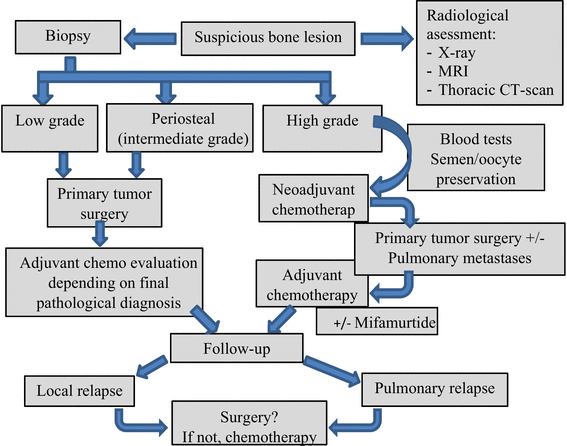 Fig.1 Diagnostic and therapeutic algorithm of osteosarcoma. (Redondo A, et al., 2017)
Conventional Diagnosis for Osteosarcoma
The conventional diagnosis of osteosarcoma is a multi-step process that begins when clinical symptoms or radiological findings raise suspicion. This pathway relies on a synergistic combination of advanced imaging to locate and stage the tumor, followed by histopathological analysis of a tissue sample to provide a definitive diagnosis. Together, these methods form the cornerstone of pre-treatment planning, determining the tumor's extent and confirming its pathological subtype.
Diagnostic Imaging: Locating and Staging the Lesion
Imaging serves as the critical first line of investigation. A plain X-ray is often the initial study, revealing classic signs such as a destructive bone lesion, the "sunburst" periosteal reaction, and Codman's triangle. Once a malignant bone tumor is suspected, magnetic resonance imaging (MRI) of the entire involved bone is essential for local staging, as it exquisitely details the intramedullary tumor extent, soft tissue mass, and involvement of critical structures like growth plates and neurovascular bundles. For systemic staging, a CT scan of the chest is the primary tool to detect the most common site of metastasis—the lungs—while a bone scan may be used to identify other skeletal metastases.
The Gold Standard: Histopathological Confirmation
Despite the strong evidence from imaging, a definitive diagnosis of osteosarcoma requires histopathological examination of tissue obtained via biopsy. This procedure provides the unequivocal proof of malignancy by revealing the presence of osteoid, an eosinophilic, amorphous matrix produced directly by the malignant stromal cells. The biopsy not only confirms the diagnosis but also allows for subtyping (e.g., osteoblastic, chondroblastic) and grading, which are vital for prognosis and treatment planning. A carefully planned and executed biopsy is therefore an indispensable step in the diagnostic pathway.
Biomarkers for Osteosarcoma Diagnostics
Beyond the foundational imaging and histology, biomarkers and in vitro diagnostic (IVD) assays are playing an increasingly critical role in the modern management of osteosarcoma. These laboratory-based tools provide vital, objective data on disease activity, prognosis, and treatment response, moving diagnosis towards a more precise and personalized paradigm. They serve as measurable indicators that complement traditional methods, offering a dynamic view of the tumor's behavior.
Serum biomarkers provide a crucial, minimally invasive means to glean vital information about osteosarcoma activity and behavior from a simple blood test. While not typically used for initial detection, they serve as powerful tools for assessing prognosis, monitoring response to therapy, and detecting early signs of recurrence.
- Alkaline Phosphatase (ALP): An elevated level at diagnosis is a classic prognostic indicator of higher tumor burden.
- Lactate Dehydrogenase (LDH): A high level signifies increased cellular turnover and aggressive disease.
- Circulating Tumor DNA (ctDNA): An emerging marker for detecting minimal residual disease and genomic evolution.
Tissue-based biomarkers provide clear diagnostic and prognostic information by directly analyzing tumor tissue, thereby enabling precise subtype classification and personalized treatment strategies.
- SATB2 (IHC): A highly specific immunohistochemical marker for confirming osteoblastic differentiation.
- TP53 & RB1: Key tumor suppressor genes frequently mutated in osteosarcoma pathogenesis.
- Complex Karyotype: Characterized by numerous chromosomal aberrations and genomic instability.
- ATRX Mutations: Associated with alternative lengthening of telomeres (ALT) and genomic instability.
Emerging Diagnostic Technologies and Future Directions
The landscape of osteosarcoma diagnosis is being transformed by several converging technologies. Liquid biopsy, particularly the analysis of circulating tumor DNA (ctDNA), offers a minimally invasive method for monitoring treatment response and detecting minimal residual disease. Simultaneously, artificial intelligence (AI) and radiomics are unlocking new prognostic insights from standard imaging by identifying patterns invisible to the human eye. Furthermore, comprehensive molecular profiling through advanced sequencing and multiplex assays is paving the way for a more precise, molecularly-driven diagnostic and stratification paradigm.
Featured Products for Osteosarcoma Diagnostics
Leveraging a powerful team and an advanced technological platform, Alta DiagnoTech provides a comprehensive suite of high-precision IVD solutions for osteosarcoma. Our portfolio delivers critical, actionable data to clinicians, enabling informed decision-making across the entire patient care pathway, from initial differential diagnosis and prognostic assessment to therapy monitoring. If you have related needs, please feel free to contact us for more information or product support.
| Product Name |
Technology |
Application |
| SATB2 Immunohistochemistry (IHC) Assay |
Immunohistochemistry (IHC) |
Aid in the confirmation of osteoblastic lineage and differential diagnosis from other sarcomas. |
| Total Alkaline Phosphatase (ALP) Assay |
Enzymatic Colorimetric Assay |
Prognostic assessment and monitoring of therapeutic response. |
| Lactate Dehydrogenase (LDH) Isoenzyme Analysis |
Immunoassay / Electrophoresis |
Evaluation of disease burden and monitoring of treatment efficacy. |
| Comprehensive Sarcoma DNA Sequencing Panel |
Next-Generation Sequencing (NGS) |
Genomic profiling for mutation identification (e.g., TP53, RB1) and therapeutic targeting. |
| Circulating Tumor DNA (ctDNA) Detection Assay |
qPCR / Digital PCR |
Minimally invasive monitoring of minimal residual disease (MRD) and tumor dynamics. |
| Bone Turnover Marker Panel (CTX, P1NP) |
Chemiluminescent Immunoassay (CLIA) |
Assessment of bone remodeling activity and treatment-related bone health. |
Reference
- Redondo A, Bagué S, Bernabeu D, et al. Malignant bone tumors (other than Ewing's): clinical practice guidelines for diagnosis, treatment and follow-up by Spanish Group for Research on Sarcomas (GEIS)[J]. Cancer chemotherapy and pharmacology, 2017, 80(6): 1113-1131.
This article is for research use only. Do not use in any diagnostic or therapeutic application.