Drug abuse remains a pervasive public health issue with far-reaching consequences for individuals, families, and societies worldwide. The misuse of substances, including opioids, stimulants, and cannabinoids, leads to a myriad of health problems, ranging from acute intoxication to chronic diseases and even death. These substances can wreak havoc on the human body and mind, causing severe physical and psychological damage. For instance, opioid addiction can lead to respiratory depression and overdose, while long-term stimulant use may result in cardiovascular issues and mental health disorders. According to the World Health Organization (WHO), drug abuse contributes significantly to the global burden of disease, affecting millions of people each year. The toll on individuals and their families is immense, often leading to broken relationships, financial ruin, and a diminished quality of life.
The economic impact is equally staggering, with costs associated with healthcare, lost productivity, and criminal justice activities running into billions of dollars annually. Healthcare systems are strained by the need to treat acute and chronic conditions related to drug abuse, from emergency room visits for overdoses to long-term care for addiction-related illnesses. Lost productivity due to absenteeism, reduced work performance, and unemployment further exacerbates the economic burden. Additionally, the criminal justice system incurs significant costs related to law enforcement, incarceration, and rehabilitation efforts. In this context, the development of effective diagnostic tools and strategies for identifying and managing drug abuse is of paramount importance. Early detection and intervention can mitigate the severity of addiction, reduce healthcare costs, and improve overall public health outcomes. Innovative approaches, such as advanced drug testing technologies and personalized treatment plans, are essential in addressing this complex and multifaceted issue.
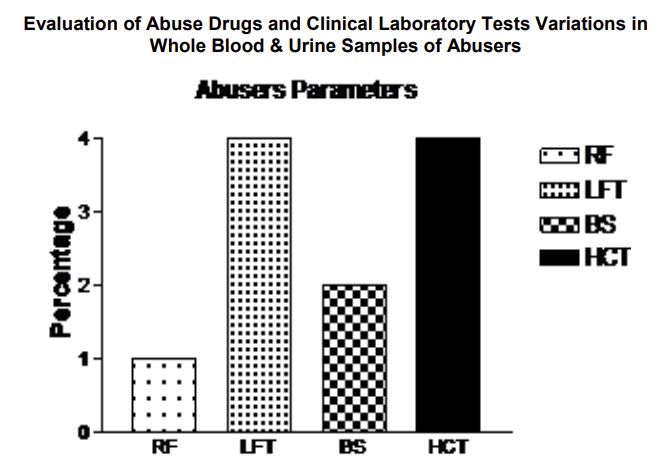 Fig.1 Percentage of abusers parameters variations. RF = Renal failure; LFT = Liver function test; Liver enzymes: ALT, AST, ALP; BS = Blood sugars; Decrease blood sugars; HCT = Hematocrite increase, mild erythropoiesis. (Basiri Ma. R., et al., 2018)
The Role of Clinical Laboratory Testing in Drug Abuse Detection
Clinical laboratory testing plays a pivotal role in the detection and monitoring of drug abuse. These tests provide healthcare professionals with critical information about the presence and concentration of drugs in biological samples, enabling them to make informed decisions regarding patient care. The most commonly used specimens for drug testing are urine and blood, each offering unique advantages and limitations.
Urine Drug Testing
Urine drug testing is the most widespread method for detecting drug metabolites due to its non-invasive nature and relatively long detection window. The process involves collecting a urine sample and analyzing it for the presence of specific drugs or their metabolites using immunoassay techniques, followed by confirmation with more sensitive methods such as gas chromatography-mass spectrometry (GC-MS) or liquid chromatography-tandem mass spectrometry (LC-MS/MS).
One of the key advantages of urine testing is its ability to detect a wide range of substances, including opioids, stimulants, benzodiazepines, and cannabinoids. However, urine tests can be subject to false positives and negatives due to factors such as cross-reactivity with other substances, adulteration, and dilution.
Blood Drug Testing
Blood drug testing, on the other hand, offers a more direct measure of drug concentration in the body, making it particularly useful for assessing acute intoxication and monitoring treatment adherence. Blood samples are typically analyzed using similar chromatographic techniques as urine, providing high sensitivity and specificity.
The primary advantage of blood testing is its ability to provide real-time information about drug levels, which is crucial in emergency situations and for adjusting medication dosages. However, blood collection is more invasive than urine collection, and the detection window is generally shorter, limiting its utility for detecting past drug use.
Advances in Drug Testing Technologies
Recent years have witnessed significant advancements in drug testing technologies, enhancing the accuracy, sensitivity, and speed of detection. These innovations include the development of point-of-care testing (POCT) devices, which enable rapid on-site testing without the need for sophisticated laboratory equipment.
Point-of-Care Testing (POCT)
POCT devices, such as lateral flow immunoassays, offer a convenient and cost-effective solution for drug testing in various settings, including clinics, workplaces, and criminal justice systems. These tests provide quick results, often within minutes, making them ideal for screening purposes. However, their sensitivity and specificity may vary, and positive results typically require confirmation with more definitive laboratory tests.
High-Performance Liquid Chromatography-Tandem Mass Spectrometry (HPLC-MS/MS)
HPLC-MS/MS represents the gold standard in drug testing, offering unparalleled sensitivity and specificity for a wide range of substances. This technique combines the separation capabilities of high-performance liquid chromatography with the detection power of tandem mass spectrometry, enabling the simultaneous identification and quantification of multiple drugs and their metabolites.
The primary advantage of HPLC-MS/MS is its ability to detect low concentrations of drugs, even in complex biological matrices. However, the technique requires specialized equipment and trained personnel, making it more suitable for centralized laboratories than for point-of-care settings.
Clinical Implications of Drug Testing Results
The interpretation of drug testing results is a highly nuanced process that demands a comprehensive understanding of the pharmacological properties of the substances involved, as well as the individual's medical history and specific circumstances. Positive results may indicate recent drug use, but the context is crucial; for instance, the timing of use and the half-life of the substance can affect when and how it is detected. Conversely, negative results do not necessarily rule out drug abuse, especially in cases of intermittent use or attempts to adulterate samples. Understanding these complexities is essential for making informed clinical decisions.
- Opioid Use Disorder
Opioid use disorder (OUD) is a significant and growing public health challenge, affecting millions of individuals worldwide. The misuse of prescription opioids, heroin, and synthetic opioids like fentanyl has led to a surge in overdose deaths and addiction-related issues. Clinical laboratory testing plays a crucial role in the diagnosis, management, and ongoing care of individuals with OUD. It enables healthcare professionals to monitor treatment adherence, detect relapse, and adjust treatment plans as needed.
Methadone and buprenorphine, two medications commonly used for opioid replacement therapy, can be detected in both urine and blood samples. Regular testing ensures that patients are receiving the appropriate dosage and helps prevent the diversion of these medications for non-medical use. This is particularly important, as the misuse of these medications can lead to serious health risks and further complications. Accurate and reliable testing is essential for maintaining the integrity of the treatment process and supporting patient recovery.
- Stimulant Use Disorder
Stimulant use disorder, which includes the misuse of substances such as cocaine, amphetamines, and methamphetamine, presents additional challenges for clinical laboratory testing. These drugs are rapidly metabolized and eliminated from the body, making detection more difficult, especially for infrequent users. The short detection windows mean that timing is critical; a test conducted too late may yield false-negative results, even if the individual has used the substance.
Advanced chromatographic techniques, such as high-performance liquid chromatography coupled with tandem mass spectrometry (HPLC-MS/MS), are essential for accurately detecting and quantifying stimulants in biological samples. These sophisticated methods offer high sensitivity and specificity, enabling the detection of even trace amounts of drugs and their metabolites. Additionally, the identification of specific metabolites can provide valuable information about the timing and extent of drug use. For example, the presence of certain metabolites can help differentiate between recent use and residual levels from past use, providing a more accurate picture of the individual's substance use patterns.
Case Study: Drug Abuse Detection in Tabriz, Iran
A recent study conducted in Tabriz, Iran, provides valuable insights into the application of clinical laboratory testing for drug abuse detection. The study examined 500 urine and 500 blood samples from individuals undergoing detoxification or maintenance treatment at welfare organization clinics.
- Methodology
The study utilized rapid strip tests for initial screening, followed by confirmation with thin-layer chromatography (TLC). Clinical laboratory tests were also performed to assess liver and renal function, as well as hematological parameters.
- Results
The results revealed a high prevalence of positive drug tests, with opioids and stimulants being the most commonly detected substances. Notably, the study highlighted the importance of blood testing in confirming drug use, particularly in cases where urine tests yielded false negatives due to adulteration or dilution.
- Clinical Implications
The findings underscored the need for comprehensive drug testing protocols that incorporate both urine and blood samples. Additionally, the study emphasized the value of clinical laboratory tests in monitoring organ function and identifying potential health complications associated with drug abuse.
Conclusion: Toward a Multifaceted Approach to Drug Abuse Management
The fight against drug abuse requires a multifaceted approach that integrates accurate diagnostic tools, effective treatment strategies, and robust public health policies. Clinical laboratory testing plays a central role in this endeavor, providing healthcare professionals with the information they need to make informed decisions about patient care.
Advances in drug testing technologies, such as POCT devices and HPLC-MS/MS, have enhanced the accuracy, sensitivity, and speed of detection, enabling more timely and effective interventions. However, the interpretation of drug testing results requires a nuanced understanding of the pharmacological properties of the substances involved, as well as the individual's medical history and circumstances.
Ultimately, addressing the drug abuse epidemic demands a collaborative effort from healthcare providers, policymakers, and communities. By leveraging the power of clinical laboratory testing and embracing a comprehensive approach to drug abuse management, we can unveil the shadows of this pervasive public health issue and pave the way for a healthier, drug-free future.
If you have related needs, please feel free to contact us for more information or product support.
Reference
- Basiri, Majid Rezaei, et al. "Evaluation of abuse drugs and clinical laboratory tests variations in whole blood & urine samples of abusers." Journal of Pharmacy and Pharmacology 6 (2018): 69-76.
Drug Abuse Test Kits (ICT)
This article is for research use only. Do not use in any diagnostic or therapeutic application.